
It’s Not Just about Chickens & Eggs
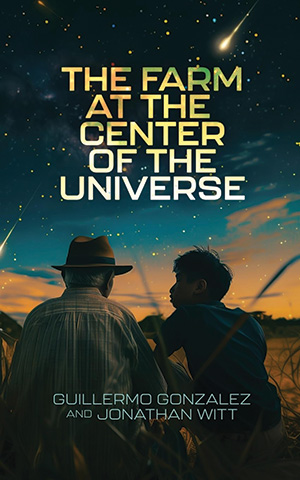
Editor’s note: For this Operation ID, we are pleased to offer an excerpt from the recently published ID-themed young adult novel The Farm at the Center of the Universe, by Guillermo Gonzalez and Jonathan Witt. We begin with the novel’s back cover description, then jump into the action in the middle of Chapter 2.
Why did Isaac’s father have to die so young? Isaac’s older cousin Charlie—a science teacher—says he knows why. Nature is pitiless. There’s no God. No afterlife. Just atoms in the void and the struggle for survival. Charlie says a week at their grandparents’ farm, seeing animals get killed and eaten, will prove it. But at the farm, both of them get more than they bargained for. And soon Isaac finds himself caught in a battle of wits between two men, and facing a choice he alone can make.
From Chapter 2: “Which Came First?”
Back at the house, Isaac and Grandpa found Charlie seated at the kitchen table sipping coffee while Grandma bustled about putting breakfast on the table. When they were all seated, they said grace and then Grandpa signaled Isaac to serve himself
and start the food around.
“The milk cows have it pretty easy, I guess,” Isaac said to make conversation. “That’s the closest I’ve ever been to one.”
“The life of a farm animal is simple,” said Grandpa. “Eat, sleep, poop, make babies, repeat.
But the life in the animal is anything but simple.”
He plucked an egg out of the basket. “Consider this simple egg. Hidden in its cells are instructions to grow into an adult chicken. If we could unwind the instructions, they’d fill enough books for an entire bookshelf. You’ve heard the riddle, ‘Which came first, the chicken or the egg?’”
“Sure,” said Isaac. “So, what’s the answer?”
“Well, a chicken grows from an egg, but an egg comes from a chicken. So how does evolution get something like that started? There is also this: a female chicken won’t lay an egg that develops into a chick without a male chicken, so really you need two chickens and an egg if the chicken species is going to make a go of it. This sort of problem crops up all over the place in biology. Enough that it has a name—the chicken-and-egg problem. In the end, you have to say that life comes from life.”
Charlie cut in. “Nowadays, sure. Nowadays life comes from life. But on the early Earth, life started from non-life. Chemicals. Then it was evolution by baby steps. A tiny mutation in one generation. Then another tiny mutation two or three generations later. On and on for millions of years. Mutations and natural selection. Survival of the fittest. That’s evolution.”
Grandpa buttered a piece of toast as he answered. “Presto chango, just like that—only in slow motion. Color me skeptical.”
The small, wry smile that Grandma gave Isaac from across the table told him this was not a new argument between Charlie and Grandpa.
“How do you explain sudden life where there was no life?” Grandpa asked, leaning forward. “And how do you explain all the specific little mutations?”
“I just told you,” said Charlie, reaching for the jam. “Random mutations, natural selection.”
“You said that, yes. But what is the particular evolutionary pathway to build all that? The particular random mutations. Just start with the hen.”
Isaac blinked, and Grandpa winked at him.
Charlie crossed his arms. Since he was a middle school teacher built like a linebacker, he wasn’t used to being challenged. “Well, I can’t tell you the specifics,” he said. “I’m not a chicken evolution expert. I’m just telling you, they have it all worked out.”
Grandpa finished his toast as he considered. “Back in my teaching days—”
Grandma interrupted him with a laugh. “You make it sound like it was a hundred years ago. You retired three years ago.”
Isaac tried to remember what his dad had told him about Grandpa’s job. “Abuelo, what kind of teacher were you?” Isaac asked.
“And I never blew myself up, even once,” said Grandpa, with mock seriousness. “One nice thing about my work was that I got to rub shoulders with professors from many fields. If I had a question about Shakespeare, there was a Shakespeare scholar two tables over in the faculty dining hall. A question about astronomy? I passed an astronomer on the way to class every Tuesday and Thursday. I had many questions about biology, and so I had many conversations with biologists. Most of these fellows, like Charlie, believed evolution explained all this.”
He gestured out the window. “So I would ask them about the chicken-and-egg problem. Because I wanted to understand. Not just about chickens and their eggs but other things too. Anything where you need A to get B, but you need B to get A, and without both, the other can’t survive. How would slow-going evolution conjure up both of them, do it at close to the same time, and get them coordinated and running smoothly?”
“What are some examples,” asked Isaac, “besides, you know, actual chickens and eggs?”
Grandpa thought for a moment and then, clearly getting an idea, he reached over and squeezed Isaac’s arm. “Here’s an interesting one. To work right, your muscles and other tissues in your body—and in every animal’s body—need oxygen. But the tissues can’t get enough oxygen without this cunning little protein called hemoglobin. The recipe for hemoglobin requires iron, and your bone marrow is where fresh hemoglobin is cooked up. Now here’s where you run into a problem if you want nature to evolve this system one manageable little step at a time. The iron you need to make hemoglobin comes into your blood through your digestive system, and that blood has to be pumped by your heart to deliver the iron to your bone marrow. But for your heart to manage this, it needs a lot of oxygen, which it gets thanks to iron-rich hemoglobin. Without hemoglobin and the iron it contains to carry enough oxygen to the heart, the heart couldn’t pump enough iron-rich blood to the hemoglobin factory in the bone marrow. So how did hemoglobin evolve in the first place and get fitted into this complex system when nature needs hemoglobin to make hemoglobin?”
Grandpa paused and then asked, “Does your brain have room for one more example?”
Isaac grinned. “Go ahead. If my brain explodes, we’ll know the answer was no.”
“Okay, this one you could call the granddaddy of all chicken-and-egg problems.”
“The abuelo of all chicken-and-egg problems,” Isaac interjected.
Grandpa laughed. “Sure, the abuelo of all chicken-and-egg problems. Here goes. All life is run on biological information, like the code you find in computer software. It’s run using what’s known as DNA. DNA is the stuff detectives collect to try to identify who was at the scene of a crime. Your DNA is unique to you. Charlie’s DNA is unique to Charlie. Each of us has his own unique DNA software program in our cells. No DNA, no life. But you need DNA to make what’s known as RNA. And you need RNA to make all the different protein machines your body needs to survive. And you need proteins to make DNA and RNA. Round and round it goes. You need all of them for all of them to work and keep you alive. Evolutionists have tried to come up with workarounds to explain how evolution could have managed all this. Maybe things started off with RNA and evolved from there, they say. It’s called the RNA World Hypothesis. But even the evolutionists can’t agree on the idea, it’s so far-fetched.”
Grandpa shook some oregano onto his scrambled eggs and took a bite. “And it gets even worse,” he said the moment he had swallowed. “You need dozens of different types of enzymes to make DNA. But it takes DNA to make enzymes. We could fill a book with these sorts of problems. Someone might think, evolutionists probably have solved most of them, and there are just a handful of puzzlers they are still trying to solve. No. They have not solved any of the really thorny ones. The best they have done is offer vague stories with very many missing steps. So the question remains: How could mindless evolution have built these systems bit by bit? Until the system is up and running, plants and animals don’t have a chance. I asked the evolutionists at my university a lot of questions like this, until it got to where they ran when they saw me coming.”
“Nonsense,” said Grandma, swatting him on the shoulder with her dish towel. “Some of them were your good friends.”
Grandpa nodded and shrugged. “At least on days when we had all woken up on the right side of the bed. But I would ask them these questions—these were experts, mind you, PhD biologists—and they all gave me the same answer in one form or another.”
There was a pause. Grandpa waited, glancing around the table expectantly. Charlie stared at his plate.
“What was it?” said Isaac. “What was their answer?”
“The same answer Charlie gave.” Grandpa beamed at him. “Each one said he or she wasn’t an expert on that particular issue, but that some evolutionist somewhere was sure to have it all worked out.”
Isaac took a bite of his bacon to hide his smile. He was pretty sure Grandpa had set this whole thing up to mess with Charlie.
“And when I finally found a specialist on one of these systems,” said Grandpa, “he said biologists are still working on that problem, but evolutionists have it all worked out most everywhere else. I did some digging in the science journals, and it was more of the same. The proof was always just around the corner, just over the next rise, just past the next bend. The answers were always of the ‘trust me, trust science’ variety.”
Charlie looked up. “So all of science is wrong,” he said, his tone tight. “You’re right, and science is wrong, that it?”
“Not science,” said Grandpa. “I’m saying the scientific evidence is telling us that mindless evolution didn’t build all those ingenious chick-and-egg systems. Scientists are supposed to follow the evidence, but scientists are only human. A lot of scientists love the theory of evolution, and they don’t want to toss it overboard.”
“You think the theory of evolution is a mistake.” Charlie spoke as if Grandpa had said the earth was flat.
“Everyone makes mistakes,” Grandma said
comfortingly, patting Charlie’s shoulder. “Even scientists.”
Guillermo GonzalezGuillermo Gonzalez, Ph.D., is a research scientist with the University of Alabama-Huntsville and a senior fellow with Discovery Institute's Center for Science and Culture. He has received fellowships, grants, and awards from NASA, the University of Washington, the Templeton Foundation, and the National Science Foundation and has published nearly 70 articles in astronomy and astrophysical journals.
Get Salvo in your inbox! Jonathan WittPhD, is Executive Editor of Discovery Institute Press and a Senior Fellow with Discovery Institute’s Center for Science and Culture. He is the author or coauthor of numerous works, including Intelligent Design Uncensored, The Hobbit Party, A Meaningful World, and the new intelligent design young-adult novel The Farm at the Center of the Universe with astrobiologist Guillermo Gonzalez.
Get Salvo in your inbox! This article originally appeared in Salvo, Issue #71, Winter 2024 Copyright © 2026 Salvo | www.salvomag.com https://salvomag.com/article/salvo71/which-came-first


