
Is the Aurora Borealis a Beautiful Wonder or a Portent of Doom?
The Los Angeles basin, home to nearly 20 million people (including me), is also home to many millions of LED lights that shine throughout the night. Due to their brightness and our low latitude (just 34° north), local residents who’ve seen the aurora borealis (figure 1) likely traveled much closer to one of the poles to capture the spectacle. I once caught a good view from a few miles east of Pasadena in 1989—a dimly glowing, motionless red spot about 30 times larger than the Moon’s diameter in the sky.
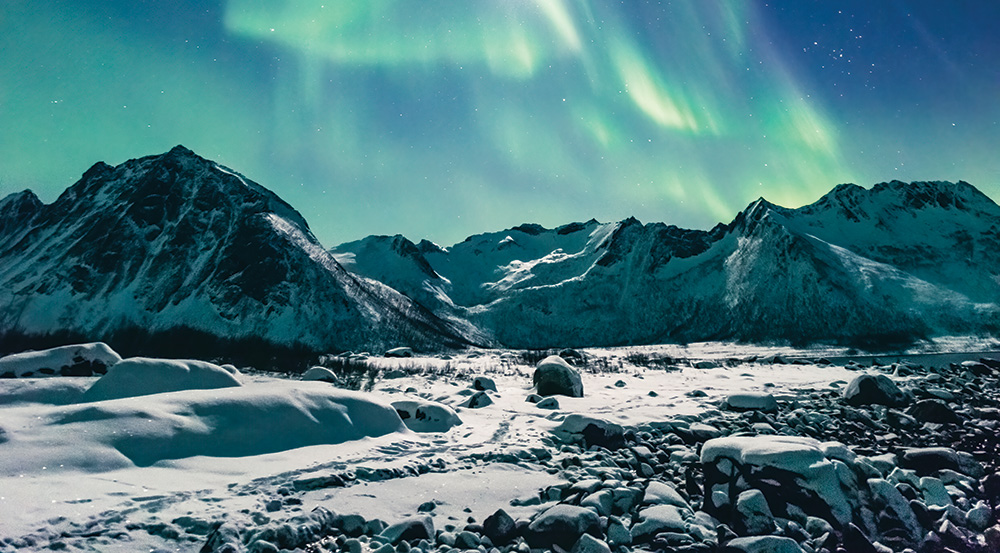
While growing up in British Columbia, I often set up my telescope in dark-sky locations where I was able to see the aurora on occasion. One time it filled the entire night sky, flashing brightly all the colors of the rainbow streaming back and forth in undulating waves. The ongoing display made my planned observation of stars, nebulae, and galaxies impossible. Momentarily disappointed, I shut down my telescope and settled in to enjoy the magnificent light show.
Auroras & Solar Flares
Auroras are visible from Earth roughly a day or two after a large solar flare—if the flare is aimed in Earth’s direction. Flares are most common during solar maximum, the time when the Sun’s approximately 11-year cycle of electromagnetic activity reaches a peak. Sunspots (dark regions of strong magnetic flux) are most abundant and clearly visible during solar maximum. Some may be as large as ten times Earth’s diameter. These sunspots are responsible for spawning “eruptive disturbances,” including solar flares.
This year, 2024, the Sun is approaching the peak of its electromagnetic cycle, and its flaring has already provided a spectacular aurora display seen as far south as the California-Mexico border. Solar maximum will extend for another year or longer. So more auroral displays like the ones seen May 10–11 are certainly possible.
While many people are hoping for the opportunity, others have grown apprehensive about solar flaring. Digital media have fueled people’s fears about the timing of the solar maximum, and some online commenters claim that as we enter solar maximum, Earth’s magnetic field is heading toward a reversal. During a magnetic reversal, the shielding effect of Earth’s magnetic field grows weaker. However, most people seem unaware that these reversals have occurred hundreds of times since life first appeared on Earth—and without serious harm.1
Magnetic-Reversal Risk
The north and south magnetic poles continually wander, geographically and at a varying rate. Researchers note that in the twenty-first century, this wandering has accelerated. In the last 24 years the north magnetic pole has moved a little more than 1,000 kilometers in a north-northwest direction from Ellef Ringnes Island (see figure 2). That’s four times faster than it moved during the twentieth century.
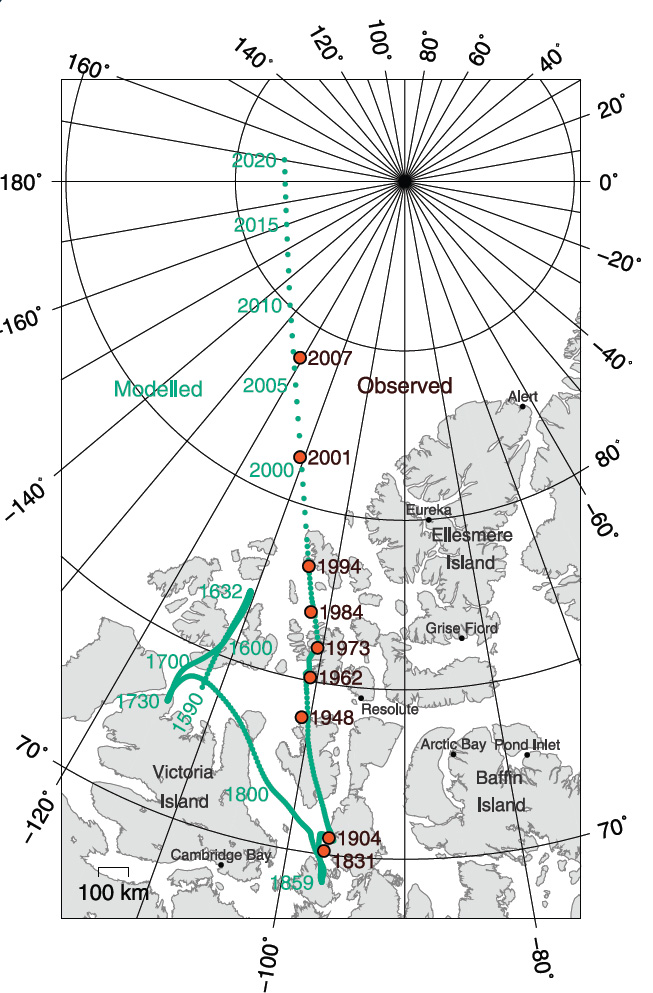
This accelerated movement has caused some scientists to speculate that Earth’s magnetic field is headed towards a reversal “soon,” sometime within the next thousand years. During a magnetic field reversal, Earth’s magnetic field drops down to 5–40 percent of its present strength. This weakening means Earth’s life experiences increased exposure to cosmic radiation and short-wavelength solar radiation, roughly double the present exposure level.
Hearing of this weakening of the magnetosphere’s protective shield is what raised fear about the purportedly deadly impact of exposure to radiation from solar flares. But these fears are misplaced, at least with respect to anticipated radiation effects on human health. None of the past several hundred reversals has led to the extinction of a single species of life.2
Stellar Flares
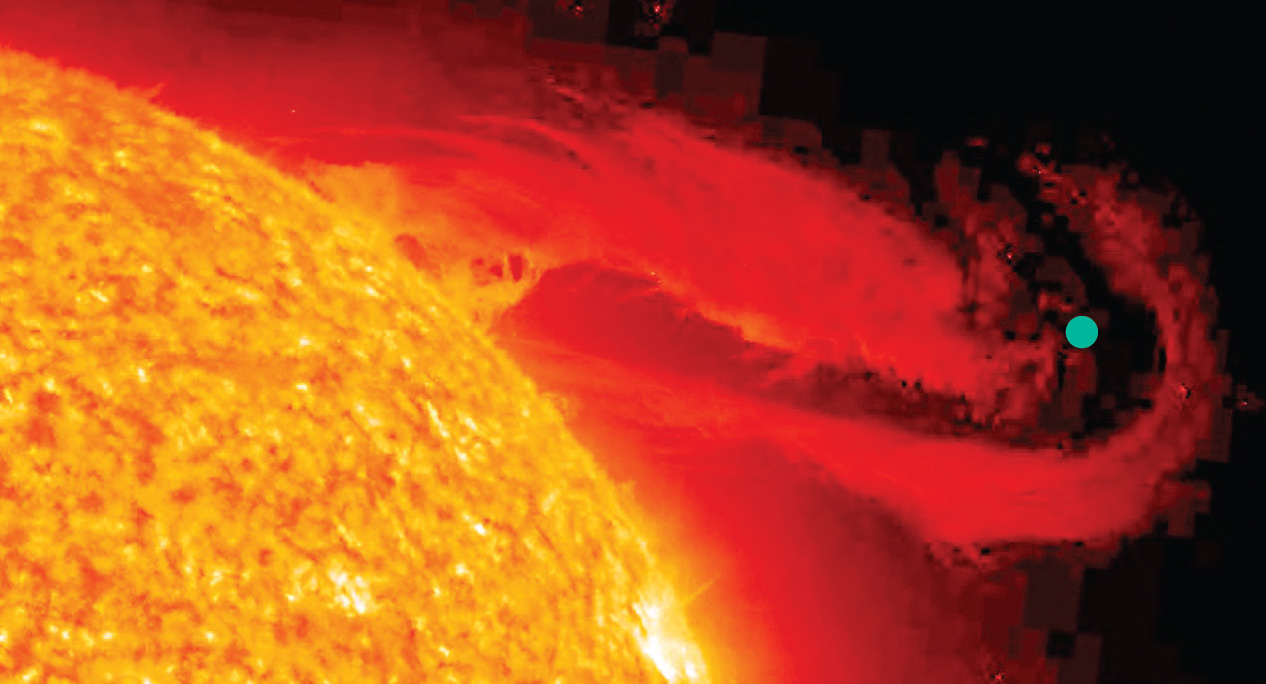
All nuclear-burning stars produce flares—explosions on the stellar surface caused by release of intense electromagnetic energy stored near starspots. Darkened spots reveal where concentrations of magnetic field flux have reduced the star’s surface temperature. Figure 3 shows a typical giant flare emanating from the Sun. It’s comforting to know that astronomers have found no other star anywhere they’ve searched with as few flares or such small flares as the Sun. This unique solar feature means advanced life is uniquely possible on Earth.
Solar-Flare Risk
Solar flares pose a risk only if and when they’re aimed directly at Earth. That risk focuses not on our life itself, but rather on humanity’s way of life. It can have a major effect on our technology. The largest solar flare measured to date took place in 1859. Its total energy release was about 1032 ergs or 2.8 quintillion kilowatt hours. The lack of any historical record of catastrophic damage of the type potentially caused by flares implies that no solar flares exceeding 1034 ergs have occurred since the launch of civilization 11,000–12,000 years ago.
The 1859 solar flare was aimed at Earth but had no direct impact on the health of humans or animals. However, it did disrupt telegraph communications all over Europe and North America. Telegraph pylons threw sparks. Telegraph operators experienced electric shocks. Some telegraph poles caught fire. However, such an event today, given our dependence on technology, would be far more significant. It would knock out most electrical power grids and many satellites we depend upon for communication and navigation. The loss of navigation satellites would seem like “the end of civilization” to people under 35. At least that’s how my sons responded to such a possibility.
People over 35 could probably get by without GPS navigation. However, loss of the electric power grids would be potentially calamitous. Lloyd’s of London insurers calculated that 20–40 million Americans would be without electricity for at least 16 days and perhaps as long as 2 years.3 The Lloyd’s insurers estimated that to repair the power grids in the contiguous 48 states would cost from $1–3 trillion.4 More devastating than the financial losses would be the enormous human death toll.
The current infrastructure that makes possible a United States population of 340 million cannot be sustained without a stable source of electricity. The loss of refrigeration, air conditioning, and heat alone would prove catastrophic. The financial losses and death toll would likely be as high or higher in other parts of the world. No region would be untouched.
In 1989, a solar flare knocked out just one electrical power grid, the Hydro-Quebec grid. It was damaged because of its proximity to Earth’s geomagnetic pole and the underlying Canadian shield which efficiently transmitted energy from the flare. Six million people were without electricity for nine hours at an economic cost of CAN $13.2 billion. Since then, the national and provincial governments have spent CAN $1.2 billion installing blocking capacitors and geomagnetically induced current monitors.
This investment ensures that the Hydro-Quebec grid will survive without significant damage from future solar flares as much as three times more powerful than the 1989 flare. It also demonstrates a principle: The cost of prevention equals a small fraction of the cost to repair the damage a major solar flare would likely cause.
In addition to installing protective infrastructure, the world’s power-grid authorities would be wise to invest in stockpiling those backup power-grid components most likely to be damaged by a significant flare. The high damage costs projected by Lloyd’s of London arise from the lengthy wait time projected for the manufacture of replacement parts, given current supplies and manufacturing capacity. Again, the cost to create a stockpile would be substantially lower than the cost to repair the damage without a stockpile.
Minimal Risk
As sobering as the risk from solar flares may seem, it represents, in reality, a risk of our own making, and it’s a manageable risk. Appropriate preparation could nullify it. However, the natural risk to life from our star, the Sun, could not be lower. Stars more massive than the Sun exhibit greater flaring activity. Stars less massive than the Sun exhibit greater flaring activity. Stars of the same mass as the Sun, even if very slightly younger or older, manifest dramatically greater flaring activity. Stars with a different elemental composition likewise exhibit far greater flaring activity.
All stars flare. None, however, flare as infrequently and as weakly as our Sun. What’s more, at no time in our Sun’s history has its flaring activity been as low as it currently measures. Human civilization—including our large, globally dispersed population with its high technology—is possible only because Earth orbits a unique star at the best-possible moment in that star’s history.
Remarkably, this best-possible moment coincides with the era of the Sun’s optimally stable luminosity. How stable is the Sun’s brightness? Because of its particular elemental composition, it is five times more stable than the second-most stable star yet discovered.
Thanks to solar flares, we can be awestruck by the beauty of auroral displays. Thanks to the Sun’s miraculous design and our exquisite timing with respect to the Sun’s history, we face no extinction risk from solar flares but only preventable disruptions to our technology.5
Notes
1. Hugh Ross, “Life and Magnetic Field Variations,” Today’s New Reason to Believe (blog), Reasons to Believe (April 22, 2019).
2. For details, see “Life and Magnetic Field Variations,” Ibid.
3. Trevor Maynard, Neil Smith, and Sandra Gonzalez, “Solar Storm Risk to the North American Electric Grid,” Atmospheric and Environmental Research and Lloyd’s of London Report (May 2013), pp. 4, 16.
4. Maynard, Smith, and Gonzalez, “Solar Storm Risk,” p. 4.
5. For those who’d like more ideas for managing solar-flare risks and/or more detail on the Sun’s favorable-for-life design, I recommend Weathering Climate Change (RTB Press, 2020), pp. 117–126 and Designed to the Core (RTB Press, 2022), pp 117–129, 225–228.
PhD, is an astrophysicist and the founder and president of the science-faith think tank Reasons to Believe (RTB).
Get Salvo in your inbox! This article originally appeared in Salvo, Issue #70, Fall 2024 Copyright © 2026 Salvo | www.salvomag.com https://salvomag.com/article/salvo70/sun-spotting


