
Air Pollution, Creation Stewardship & Human Wellbeing
With a metropolitan population of more than 29 million, Delhi, India’s capital, holds this unenviable distinction: world’s worst city for air quality. According to satellite data, the nation of India ranks first, or worst among all nations, especially for particulate pollution.1 This pollution is more than unpleasant for those who breathe it. It’s deadly.
Thus, the World Health Organization (WHO) keeps close watch on two forms of particulate air pollution: inhalable particles, with diameters between 2.5 and 10 micrometers, and PM2.5, inhalable particles with diameters of 2.5 micrometers or less. The main components of these two types of particulate pollution are black carbon soot, mineral dust, sulfates, nitrates, ammonia, and sodium chloride (salt).
Since 1998, satellites have been used to measure air pollution levels all around the planet. From 1998 to 2021, the average particulate pollution over India increased by 67.7 percent. Between 2013 and 2021, India was responsible for 59.1 percent of the global increase in such pollution.
In 2021, the average PM2.5 air pollution over India was 58.7 micrograms per cubic meter (µg/m3), an increase of 4.4 percent over the previous year. Meanwhile, the quantity for Delhi was 126.5 µg/m3, an increase of 18.2 percent over the previous year. Delhi’s 2021 air-pollution level was more than 25 times greater than the maximum humanly tolerable level, a number set by WHO at 5 µg/m3.
Ground-based instruments indicate that the city of Darbhanga, located in northeast India, may have an even higher PM2.5 air-pollution level than Delhi. According to their measurements, Darbhanga’s average PM2.5 level in 2021 was 175.9 µg/m3, more than 35 times greater than the WHO limit.2
Right behind India in exposing its citizens to high levels of PM2.5 air pollution are eastern China and virtually all the nations of Southeast Asia. In China, PM2.5 air pollution takes 2.5 years off the life expectancy of the average citizen, and even more from those living in the largest cities.3 In Bangladesh, Nepal, and Pakistan, the effect of PM2.5 is worse yet, shortening average life expectancy by five years.4 The loss of life expectancy attributable to particulate pollution across all of Asia averages 3.3 years.5
Health Consequences
Those of us who have warmed ourselves near an open fire that’s pouring out copious clouds of smoke know by experience the respiratory distress this smoke causes. As it starts irritating our nasal passages and lungs, we instinctively back away, at least until the wind sends it in a different direction.
Inhalable particulates from an open fire tend to be larger than 2.5 micrometers, typically about 10 micrometers in diameter. These larger particles can penetrate deep into lungs and even into the bloodstream, where they cause serious health problems. However, the smaller PM2.5 particles actually pose the greatest health risks, such as decreased lung function, increased lung injury, fibrosis, aggravated asthma, COPD, irregular heartbeat, and increased risk of heart attack, lung cancer, and premature death in people with heart or lung disease.6 Children and older adults are most at risk from exposure.
Sadly, the PM2.5 pollution in India shows elevated levels of arsenic, tin, and lead.7 Long-term exposure to elevated levels of these elements is a known contributor to cancer and organ failure. In other words, this pollution is a slow, stealthy killer.
Impact on India’s Life Expectancy
For people living in what has now become the world’s most populous nation, PM2.5 air pollution currently shortens the average person’s life expectancy by 5.3 years.8 According to the latest Quality of Life Index, the average person living in the vicinity of Delhi would be able to live 11.9 years longer if the PM2.5 level there were reduced to 5 µg/m3 or less.9
India’s northern plains region is home to 39 percent of India’s 1.4 billion people. These 546 million people, on account of PM2.5 exposure, are on track to lose eight years of life expectancy.10 Without doubt, exposure to PM2.5 air pollution ranks as the greatest threat to life expectancy in India, ahead of cardiovascular diseases, high systolic blood pressure, and tobacco use, all of which have received serious attention in recent years while particulate pollution has been increasing.
Environmental Damage
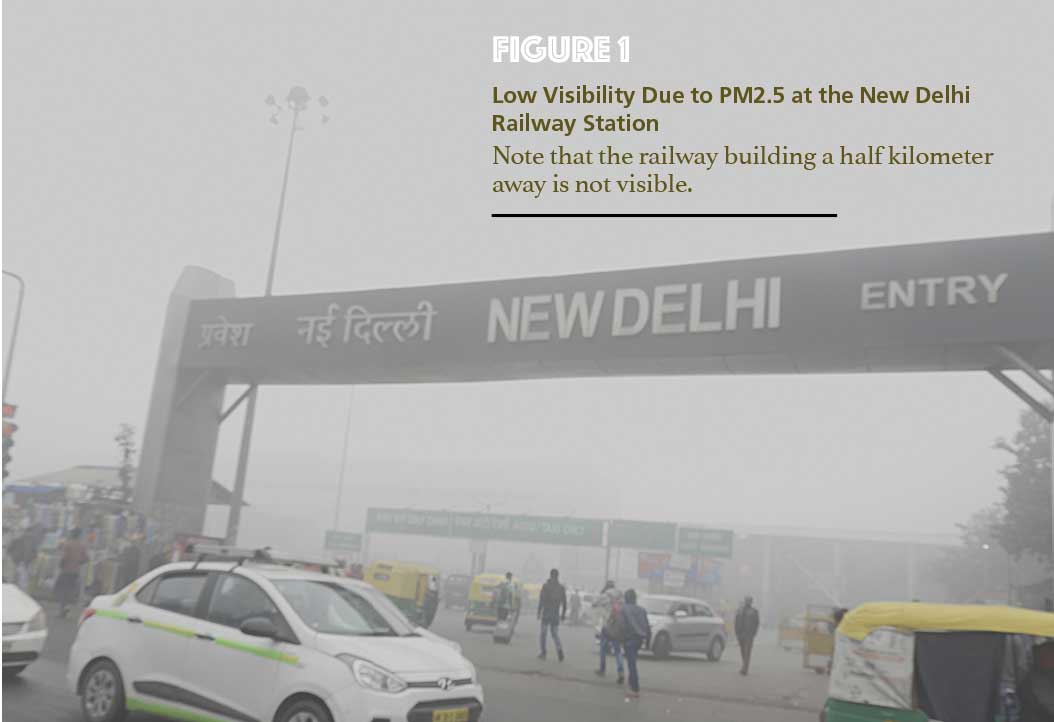
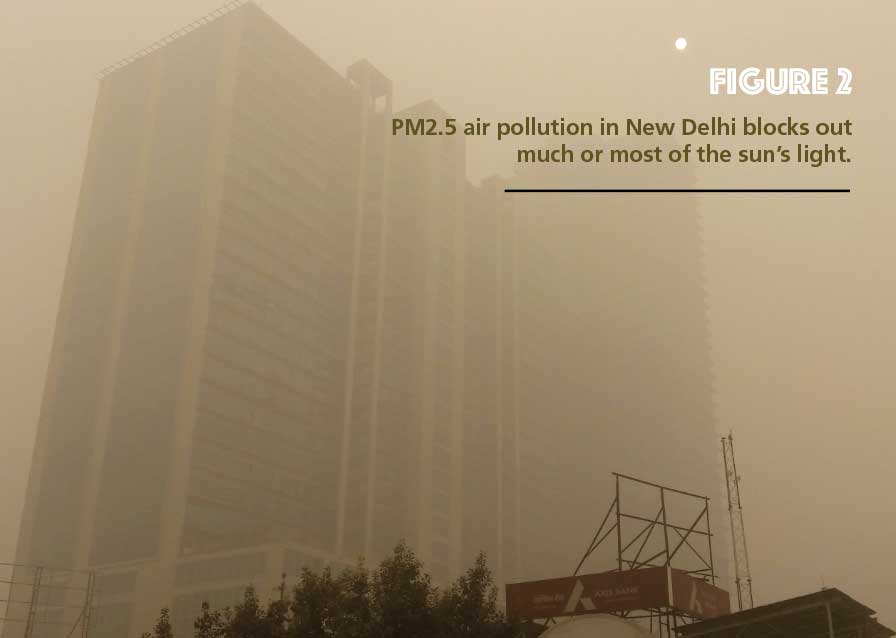
PM2.5, the primary cause of reduced visibility (haze) in the atmosphere (see figures 1 and 2), also increases the acidity of lakes, streams, estuaries, seas, and oceans. It melts snow and ice, significantly contributing to global warming by decreasing the reflectivity of Earth’s surface. It depletes soil nutrients, damages food crops, fruit trees, and forests, and even degrades buildings, bridges, monuments, and statues.
Potential Remedies
Nearly all of India’s PM2.5 air pollution comes from the burning of coal, wood, biomass, diesel, oil, and gasoline, with coal burning as the biggest contributor.11 Replacing these fuel sources with natural gas would eliminate the majority of India’s PM2.5, virtually all but the small amount arising from road and construction dust. In addition, this replacement would immediately reduce India’s carbon greenhouse gas emissions by nearly half.
Natural gas or methane (CH4) is a clean fuel in that it releases no particulates as it burns. The end products are water vapor and carbon dioxide. While both are greenhouse gases, only the carbon dioxide contributes to global warming. The extra water vapor simply condenses as rain, dew, mist, snow, hail, or frost.
In North America, natural gas is a cheaper source of fuel than coal, wood, diesel, oil, and gasoline. Consequently, natural gas is used ubiquitously for heating and for generating electricity. When truck and car engines are converted to run on natural gas, the fuel costs for these vehicles are cut in half. Thus, for most North Americans and Western Europeans, exposure to PM2.5 air pollution is not a health risk. By switching to natural gas, Canada, the United States, and Western Europe saw the most dramatic drop, among all the world’s nations, in greenhouse gas emissions.
Barriers to Remediation
While natural gas is abundant and relatively inexpensive in North America, such is not the case in India, China, and Southeast Asia. Why? North America is sitting on huge natural gas reserves—enough to rid the whole world of dependence on coal, wood, diesel, oil, and gasoline fuel sources, and for less money than those Asian countries are paying now.
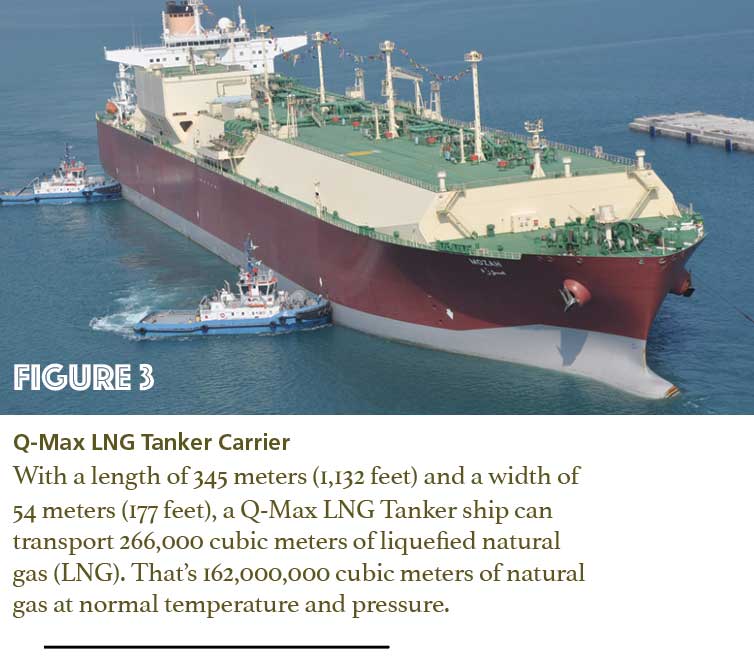
To make this resource available to the rest of the world, however, North America would have to scale up its capacity to export liquefied natural gas. Natural gas can be cooled to liquid form for ease and safety of storage and transport. Liquefied natural gas takes up only 1/600th the volume of natural gas at standard temperature and pressure conditions. Giant tanker ships have the capacity to transport the equivalent of 162 million cubic meters of natural gas to ports all over the world (see figure 3).
The problem, however, is that on January 26, 2024, the executive branch of the U.S. government decided to delay consideration of constructing any new liquefied natural gas terminals in the United States. The rationale given for this decision was to cut greenhouse gas emissions. Ironically, this decision does just the opposite. It has the effect of forcing India, China, and Southeast Asia to continue burning coal, wood, diesel, oil, and gasoline. Worse yet, it perpetuates shortening the lives of more than a billion human beings.
Spiritual Lessons
God put humans in charge of Earth’s resources to wisely manage them for our benefit and the benefit of all Earth’s life (Genesis 1:28–30). Wise management implies paying attention to unintended consequences. Cathy McMorris Rodgers, Chair of the House Energy and Commerce Committee for the United States Congress, has explained the unintended consequences of limiting LNG exports.12 While the goal of eliminating virtually all greenhouse gas emissions through the development of wind, water, solar, and nuclear power is laudable, this goal will take time to achieve—an estimated two more decades, at least.
Meanwhile, it would be prudent and life-enhancing for the nations to lower greenhouse gas emissions by replacing high-greenhouse-gas-emitting fossil fuels with the lowest-greenhouse-gas-emitting fossil fuel: natural gas. After all, natural gas is the most abundant and cost-effective fossil fuel resource available. It’s the one and only fossil fuel resource that releases no particulate matter!
The Bible calls the descendants of Adam and Eve to live compassionately, in the love and strength God alone provides, and to alleviate poverty and suffering wherever they exist. Supplying Asia with abundant natural gas would save tens of millions of lives and would alleviate widespread distress and agony among humans and animals alike. It would dramatically boost the economies of both North American and Asian nations. It would quickly reduce greenhouse gas emissions, bringing about the fastest and most dramatic mitigation of global warming and climate change. It would enhance the ecosystems of Asia and increase food and forest productivity throughout Asia. It would clear up the skies over Asian cities so that the 2+ billion people living in those cities could actually see stars at night. Once again, for billions of people the heavens could—and would—declare the glory and righteousness of God (Psalms 19:1, 97:6).
Notes
1. Michael Greenstone and Christa Hasenkopf, “Air Quality Life Index 2023: Annual Update”(August 2023); “Air Quality Life Index, India Fact Sheet” (2023).
2. IQAir, “World’s Most Polluted Cities: Most Polluted City Ranking Based on Annual Average PM2.5 Concentration (µg/m3)” (2017–2022).
3. Greenstone and Hasenkopf.
4. Greenstone and Hasenkopf.
5. Greenstone and Hasenkopf.
6. Lukasz Zareba et al., “The Relationship between Fine Particle Matter (PM2.5) Exposure and Upper Respiratory Tract Diseases,” Journal of Personalized Medicine 14, no. 1 (January 16, 2024): id. 98; Dayong Yue et al., “Diesel Exhaust PM2.5 Greatly Deteriorates Fibrosis Process in Pre-Existing Pulmonary Fibrosis Via Ferroptosis,” Environment International 171 (January 2023): id. 107706; Yonghui Yang et al., “Continuous Exposure of PM2.5 Exacerbates Ovalbumin-Induced Asthma in Mouse Lung Via a JAK-STAT6 Signaling Pathway,” Advances in Clinical Experimental Medicine 29, no. 7 (July 2020): 825–832; Ruyi Li, Rui Zhou, and Jiange Zhang, “Function of PM2.5 in the Pathogenesis of Lung Cancer and Chronic Airway Inflammatory Diseases (Review),” Oncology Letters 15, no. 5 (May 2018): 7506–7514.
7. Pallavi Pant et al., “Characterization of Ambient PM2.5 at a Pollution Hotspot in New Delhi, India and Inference of Sources,” Atmospheric Environment 109 (May 2015): 178–189.
8. “Air Quality Life Index, India Fact Sheet.”
9. “Air Quality Life Index, India Fact Sheet.”
10. “Air Quality Life Index, India Fact Sheet.”
11. Abhinandan Ghosh et al., “A District-Level Emission Inventory of Anthropogenic PM2.5 from the Primary Sources Over the Indian Indo Gangetic Plain: Identification of the Emission Hotspots,” Science of the Total Environment 914 (March 1, 2024): id. 169865; Pant et al., “Characterization of Ambient PM2.5.”
12. Cathy McMorris Rodgers, “Myth vs. Fact: Biden’s LNG Export Ban” (February 5, 2024).
PhD, is an astrophysicist and the founder and president of the science-faith think tank Reasons to Believe (RTB).
Get Salvo in your inbox! This article originally appeared in Salvo, Issue #69, Summer 2024 Copyright © 2026 Salvo | www.salvomag.com https://salvomag.com/article/salvo69/killer-air-solution


