
The Exquisite Design of Earth's Internal Thermostat
With global attention fixed on Earth's surface temperature and the relatively narrow range required for the existence and preservation of life as we know it, perhaps we may be excused for failing to appreciate the significance of Earth's just-right internal heat flow. The fact that this heat flow happens to occur within the ideal range to produce two of our planet's unique life-sustaining features seems every bit as improbable—dare I say miraculous?—as Earth's present 9,500-year window of extreme climate stability.
Recent research shows Earth to be the internal heat flow champion among rocky planets of its size and age. Earth's size and age would lead scientists to expect negligible heat transfer from the core all the way up through the mantle to the crust. On Mars, for example, the heat flow from its interior to its surface measures a paltry 7 milliwatts per square meter.1 This lack explains why Mars is missing at least two life-essential features that are sustained on Earth: long-lasting plate tectonics, and a powerful, long-lasting magnetic shield.
Some 70,000 measurements show that, on average, every square meter of Earth's continental surface is warmed by 92 milliwatts of heat flowing from Earth's interior.2 Every square meter of ocean surface is warmed by 67 milliwatts.3 (Note that heat flows more readily through continental crust, mostly silicates, than it does through oceanic crust, mostly basalts.)
On Earth's surface, incident radiation from the Sun dominates the heat flowing from Earth's interior. The Sun warms every square meter of Earth's surface by an average of 340.2 watts.4 Thus, internal heat flow accounts for only 0.024 percent of Earth's surface warmth. No wonder we don't seem to notice it. However, the Sun's incident radiation penetrates only some tens of meters into Earth's crust. Below that, internal heat flow from Earth's core and through its mantle dominates solar heat. So, without that internal heat, Earth would be as lifeless as Mars and all other known candidates for life support. This leads to questions about how Earth happened to come by this astounding level of internal, perfectly circulating heat.
Sources of Interior Heat Flow
One of the two major sources of Earth's interior heat is radioactive decay of long-half-life radioisotopes (radiogenic heat). This radiogenesis accounts for 58 percent of the total current heat flow.5 The second source is referred to as primordial heat—heat lost in the ongoing cooling process from the intensely hot accretion (gravity-induced accumulation of matter) that formed Earth.
Earth has a remarkably high level of primordial heat because of its unique formation process. Like all rocky planets, it began to form through the accretion of planetesimals, dust, and gas, a process that generated much internal heat. However, Earth's accretion history did not end there. Our planet experienced three additional accretion events, all major. The most significant occurred a little less than 100 million years after Earth's initial formation. Theia (a planet 15–45 percent of Earth's original mass) merged with the primordial Earth, increasing Earth's mass, producing the Moon, and substantially augmenting Earth's accretion heat.6 Shortly after this event, Earth received a "late veneer"—a bombardment by large asteroids and comets.7 Then, about 3.9 billion years ago, the Late Heavy Bombardment of large asteroids and comets struck the Earth.8 As a result, Earth's primordial heat from accretion rose far beyond the norm for rocky planets of its size.
Earth possesses an even more remarkable level of radiogenic heat. Compared to the calculated average abundance levels in rocky exoplanets, Earth possesses 90 times more potassium, 340 times more uranium, and 610 times more thorium, on average. 9Apparently, Earth became super-endowed with these elements due to the timing and manner by which our solar system, and Earth in particular, formed. Within the complexities of this process, all the solar planets became enriched with these elements.10 However, Earth received a super-endowment far beyond the levels of the other solar system planets.11 What's more, this endowment exists at great depth, not just in the crust, where it would dissipate rapidly, as it did on Mars 4 billion years ago.
Heat Flow Pathways
In the mid-nineteenth century, Britain's famed physicist, Lord Kelvin, assumed that all of Earth's internal heat came from a single accretion event, the condensation of Earth from planetesimals. He also assumed that this heat flowed from Earth's interior strictly via conductive cooling.12 As it turns out, both assumptions have proved incorrect.
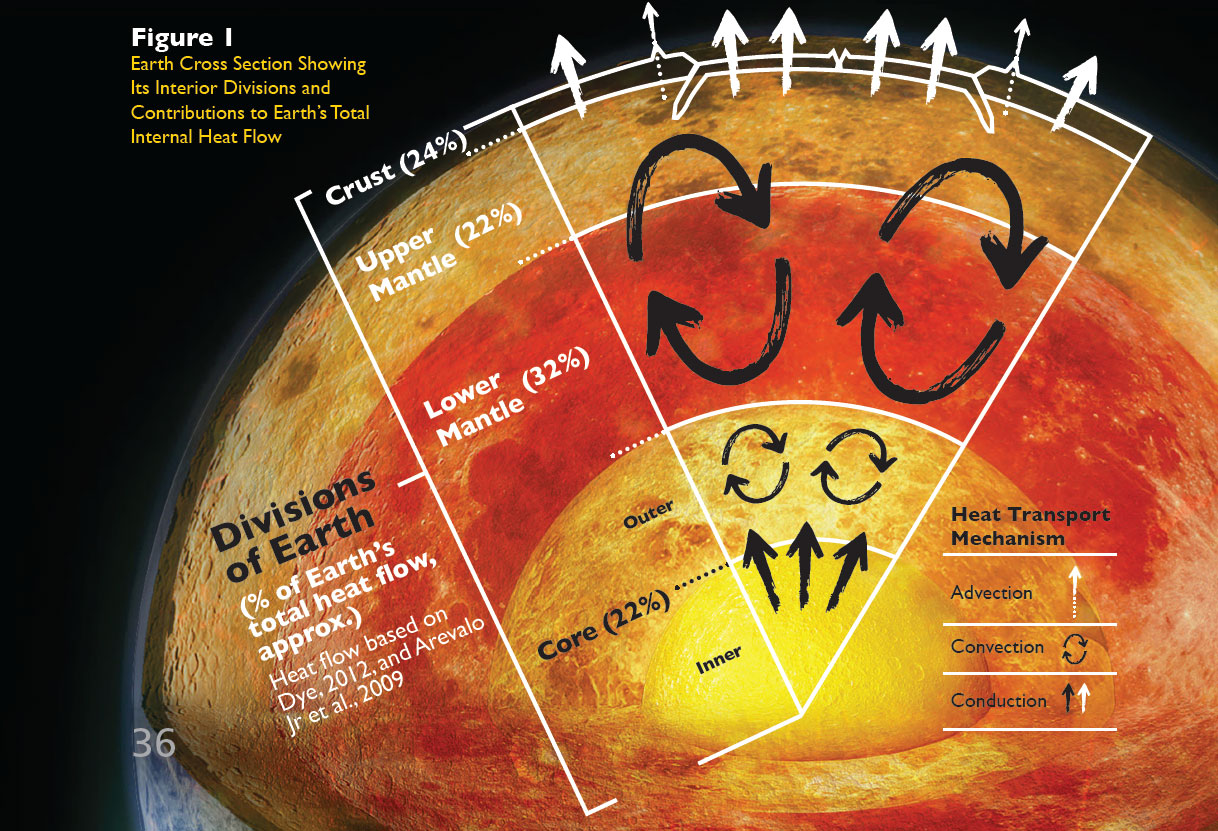
Convection plays a far more important role in heat transport than does conduction in both Earth's mantle and its liquid core (see Figure 1). For Earth's crust, the dominant heat transport mode is volcanic advection (flows of molten lava and volcanic gases). For the outer core and mantle, convection is the dominant mode, while conduction still dominates in the inner core. Convection is an important reason for Earth's sustained internal heat flow over billions of years.
History of Earth's Interior Heat Flow
Interior heat flow from both accretional and radiogenic heat changes over time. The heat left over from accretion gradually dissipates as it flows from Earth's deep interior through the mantle, through the crust, and to the surface and beyond.
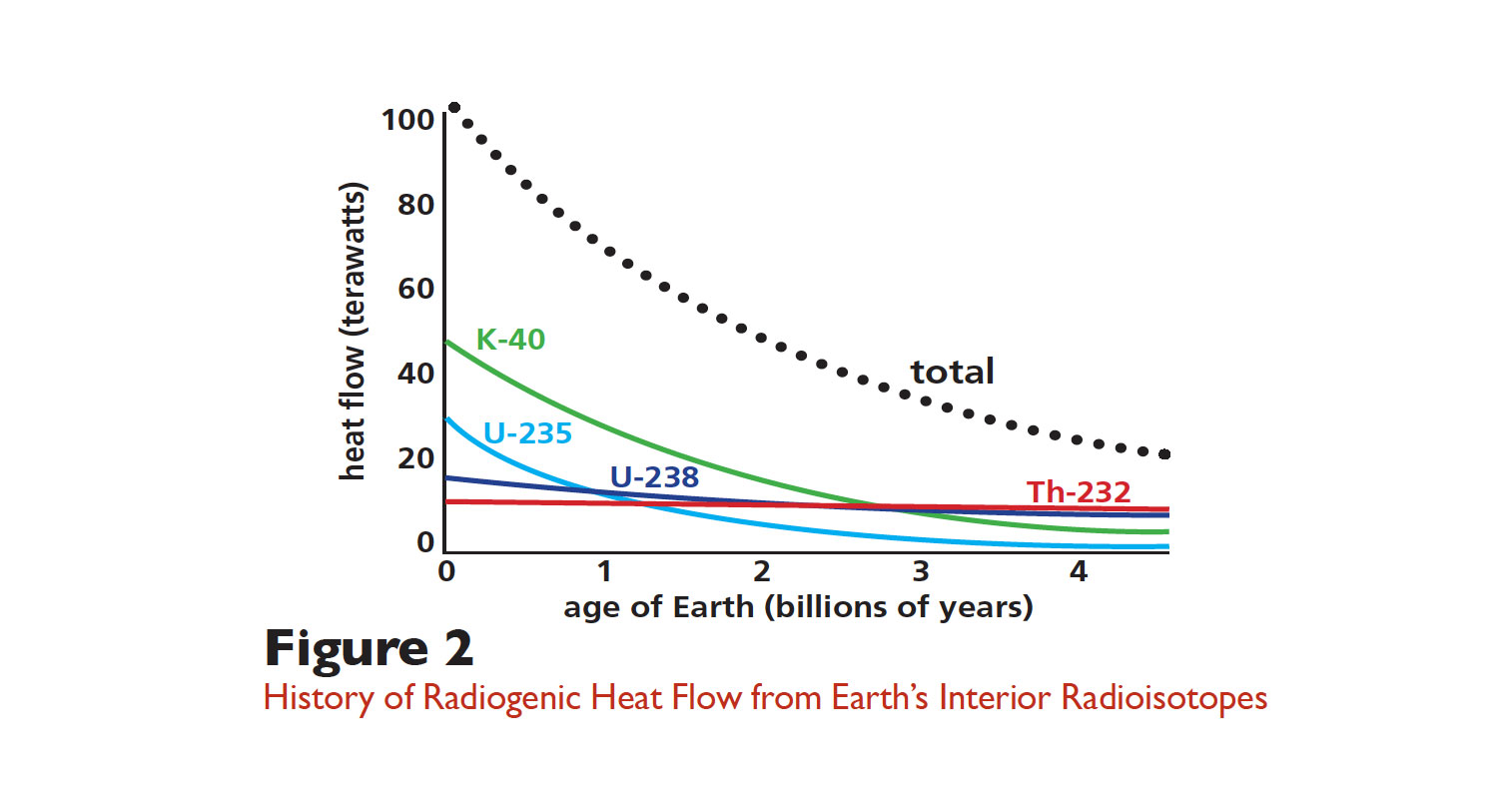
When Earth was less than 100 million years old, its radiogenic heat was dominated by several short-half-life radioisotopes. Since then, just four radioisotopes—potassium-40, thorium-232, uranium-235, and uranium-238—have accounted for more than 99 percent of Earth's radiogenic heat. Figure 2 shows the relative contributions of potassium-40 (K-40), thorium-232 (Th-232), uranium-235 (U-235), and uranium-238 (U-238) to Earth's internal heat flow throughout the past 4.5 billion years.
Favorable Effects of Earth's Interior Heat Flow
Today, the mantle temperature just under Earth's oceanic crust is 1,410°C.13 This high temperature means upper mantle material has a low viscosity (think of melted butter as compared with a cold, high-viscosity stick of butter).
Thanks to the mantle's low viscosity, tectonic plates in Earth's crust have been able to move relative to one another for the past 3.8 billion years.14 This tectonic activity transformed Earth from a waterworld to a planet with both continents and oceans on its surface. This combination of surface continents and oceans and enduring, powerful tectonic activity established the conditions for life to exist and survive. For one, they established biogeochemical cycles that kept Earth's surface temperature at an optimal level for life despite the Sun's ongoing brightening.15 For another, they maintained the recycling of many of Earth's life-essential nutrients.
Without Earth's strong, enduring interior heat flow, only microbial life could have existed anywhere on Earth, and that for only several million years—not enough time for the physical and chemical transformation of Earth's surface environment to take place that would allow for plants, animals, and humans to exist.
Meanwhile, the composition of Earth's outer core—almost entirely iron, cobalt, and nickel, all easily magnetized elements—kept liquid by the outer core's heat and driven by convection currents in the outer core, has allowed Earth to sustain a powerful magnetic field throughout at least the past 3.7 billion years.16 This powerful, enduring magnetic field has shielded Earth's surface life from both deadly high-energy particles flowing from the Sun and equally deadly high-energy cosmic rays. Also, without this shield, solar radiation would have sputtered both Earth's atmosphere and its surface water into interplanetary space.
In other words, without the powerful and enduring heat flow from the furnace in Earth's core, we would not be here. Neither would animals, trees, plants, oceans, and the atmosphere. The remarkable fine-tuning of Earth's formation, interior composition, and heat flow makes possible our high-technology civilization and our ability to recognize that we are intended to be here. We are creatures of destiny.
Notes
1. Lujendra Ojha et al., "Depletion of Heat Producing Elements in the Martian Mantle," Geophysical Research Letters 46, no. 22 (Nov. 28, 2019): 12756–12763, doi:10.1029/2019GL085234.
2. Francis Lucazeau, "Analysis and Mapping of an Updated Terrestrial Heat Flow Data Set," Geochemistry, Geophysics, Geosystems 20, no. 8 (August 2019): 4000–4024, doi:10.1029/2019GC008389.
3. Lucazeau, "Analysis and Mapping."
4. Andrew C. Kren, Peter Pilewskie, and Odele Coddington, "Where Does Earth's Atmosphere Get Its Energy?", Journal of Space Weather and Space Climate 7 (March 20, 2017): id. A10, doi:10.1051/swsc/2017007.
5. The KamLAND Collaboration, "Partial Radiogenic Heat Model for Earth Revealed by Geoneutrino Measurements," Nature Geoscience 4 (September 2011): 647–651, doi:10.1038/ngeo1205; Lucazeau, "Analysis and Mapping."
6. Hugh Ross, Improbable Planet (Baker, 2016), 48–60.
7. Ross, Improbable Planet, 57–60.
8. Ross, Improbable Planet, 65–72, 97–105.
9. Ross, Improbable Planet, 167–168.
10. Hugh Ross, Why the Universe Is the Way It Is (Baker, 2008), 45–47.
11. Ross, Improbable Planet, 43–77, 113–115.
12. William Thomson, "On the Secular Cooling of the Earth," Proceedings of the Royal Society of Edinburgh 4 (1862): 610–611, doi:10.1017/S0370164600035124. A PDF of Thomson's paper is available at https://courses.seas.harvard.edu/climate/eli/Courses/EPS281r/Sources/Earth-age-and-thermal-history/more/Kelvin-1863-excerpts.pdf.
13. Emily Sarafian et al., "Experimental Constraints on the Damp Peridotite Solidus and Oceanic Mantle Potential Temperature," Science 355, no. 6328 (March 3, 2017): 942–945, doi:10.1126/science.aaj2165.
14. The current cooling rate of Earth's mantle is 70°–130°C per billion years (Ricardo Arevalo Jr., William F. McDonouth, and Mario Luong, "The K/U Ratio of the Silicate Earth: Insights into Mantle Composition, Structure, and Thermal Evolution," Earth and Planetary Science Letters 278, nos. 3–4 (Feb. 25, 2009): 361–369, doi:10.1016/j.epsl.2008.12.023. This cooling is slow enough to pose no short-term threat to life. The cooling implies, however, that Earth's mantle will become more viscous. Eventually, its viscosity will shut down plate tectonic activity. When that happens advanced life and, eventually, all life on Earth will go extinct.
15. Hugh Ross, "Carbon Cycle Requirements for Advanced Life, Part 1," Today's New Reason to Believe (blog) (Nov. 18, 2019): https://reasons.org/explore/blogs/todays-new-reason-to-believe/read/todays-new-reason-to-believe/2019/11/18/carbon-cycle-requirements-for-advanced-life-part-1; Hugh Ross, "Carbon Cycle Requirements for Advanced Life, Part 2," Today's New Reason to Believe (blog) (Nov. 25, 2019): https://reasons.org/explore/blogs/todays-new-reason-to-believe/read/todays-new-reason-to-believe/2019/11/25/carbon-cycle-requirements-for-advanced-life-part-2.
16. Alexandra Witze, "Greenland Rocks Suggest Earth's Magnetic Field Is Older Than We Thought," Nature 576 (Dec. 10, 2019): 347, doi:10.1038/d41586-019-03807-7.
PhD, is an astrophysicist and the founder and president of the science-faith think tank Reasons to Believe (RTB).
Get Salvo in your inbox! This article originally appeared in Salvo, Issue #54, Fall 2020 Copyright © 2026 Salvo | www.salvomag.com https://salvomag.com/article/salvo54/set-for-life


