
How I Left the Stumbling Block of Evolution Behind & Found a Living Faith
I was a good student. I graduated second in my high-school class, Phi Beta Kappa from the University of Wisconsin–Madison, and with honors from Harvard Law School. But I was a dead man walking. And I had no idea.
One of the main reasons was that I truly believed what I had been taught in college about the origin of man. I majored in psychology with an emphasis on animal behavior, so I heard a lot about Darwin’s big idea—the notion that all creatures on earth, including humans, had evolved from some very simple original life form. It was taught, not as a theory, but as an unadulterated fact, with no room for dissent. Just as Britannica.com tells readers today, I was taught:
The evolutionary origin of organisms is today a scientific conclusion established with the kind of certainty attributable to such scientific concepts as the roundness of Earth, the motions of the planets, and the molecular composition of matter. This degree of certainty beyond reasonable doubt is what is implied when biologists say that evolution is a “fact.”
So my wife and I were buried in our careers for almost twenty years without ever focusing on the most important issues of life. What began to open our eyes was the birth of our identical twin daughters. We were very serious about doing right by these precious girls, including teaching them the truth about very big ideas. We knew nothing about what people referred to as “God,” but we set about to learn. Being academics, we started by reading the Bible.
My dear wife came to faith in Jesus Christ in a matter of months. This was something of a shock to me, but I could see that suddenly she was a new person. I hadn’t changed, but she had. She wanted to start attending church, so we did.
The Great Cosmogenic Myth
As I began to meet “church people,” I would ask what they thought about the theory of evolution. Without exception, they would say they did not believe in evolution, but no one ever said a word about why. Since I had been taught that evolution was an established scientific fact, I thought I would have to commit intellectual suicide if I wanted to become a Christian.
My wife was aware of these conversations, so she got me a book by Canadian astrophysicist Hugh Ross. It was the first time in my life I heard someone who was obviously very smart deny the truth of Darwin’s big idea. Ross did not discuss evolution in detail, but his book led me to another that was all about evolution: Evolution: A Theory in Crisis, by Australian molecular biologist Michael Denton.
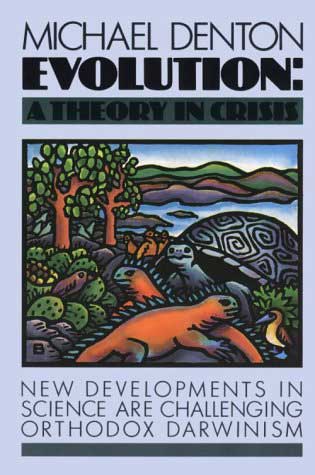
Denton’s book was all science and no Bible—fifteen chapters of scientific evidence contradicting the most basic premises of Darwin’s theory. He explained how the fossil record did not show that life on earth had developed slowly from a simple original form to the more complex. Instead, it showed that almost all the major categories of both plants and animals had exploded onto the scene all at once.
Nor did the fossil record show the many transitional forms Darwin’s theory had predicted. Instead, it showed that the first representatives of all major classes of known organisms had already been highly characteristic of their class when they first appeared. Denton explained that, while modern evolutionary biologists presume that the mechanism of evolution must also have given rise to the original form of life, the man who discovered DNA, Francis Crick, wrote that “the origin of life appears at the moment to be almost a miracle, so many are the conditions which would have had to have been satisfied to get it going.”
Denton’s scientific review of Darwin’s theory concluded with the following indictment:
One might have expected that a theory of such cardinal importance, a theory that literally changed the world, would have been something more than metaphysics, something more than myth.
Ultimately the Darwinian theory of evolution is no more nor less than the great cosmogenic myth of the twentieth century.
When I finished Denton’s book, my worldview was in freefall. I knew I had believed a story that was false. If I could be so confidently wrong about this, I could be wrong about anything. I also knew that if I was not the product of mindless mutations, there seemed to be only one other possibility. Maybe I did have a Creator. If Francis Crick could consider the possibility that the origin of life was a miracle, maybe I needed to consider the possibility that the creation of man was a miracle, too. Maybe I needed to consider the possibility that there really is a Miracle Maker who actually had done the seemingly impossible things I was reading about in the Bible.
More Questions than Faith
So my Bible study became much more intense. I spent my subway rides twice a day between suburban Maryland and my law firm in D.C. reading the Bible. At the same time, I began to read authors in the intelligent design movement and to study in depth emerging arguments both for and against Darwin’s theory.
Only much later did I realize that I was trying to study my way to God. Only later did I realize that while “finding God” had an intellectual element, it was essentially a spiritual event. I had no sense of spiritual reality. So I was working very hard but often feeling like I was getting nowhere. I had read but not paid enough attention to James 4:10: “Humble yourselves in the sight of the Lord, and he shall lift you up.” I was thinking that my brain could achieve this goal as it had achieved many other goals in life. I was thinking I could lift myself up. I had a pride problem.
When my wife and I had started reading the Bible, we had also taken a course called “Fundamentals of the Faith” at a local Bible church. It reviewed the basic doctrines of the Christian faith, and it was during that class that my wife had given her life to the Lord.
In early 1995, we invited the teacher, Steve, and his family to our home for dinner. Steve and I sat talking on our patio until late into the night. I asked him all sorts of questions about Christianity and the Bible. More eager than ever to join my wife in faith—and increasingly frustrated that I had more questions than faith—I got the idea that maybe I was already a Christian but just didn’t realize it. The conversation went like this:
Me: You know, Steve, I listened carefully to everything you had to say in the Fundamentals class. I understand the basics of Christianity. It all makes sense to me. I think I agree with almost everything you said. Maybe I am a Christian.
Steve: That’s all good, but have you been born again?
Me (after a long silence; I really didn’t know the meaning of that phrase): I don’t know.
Steve: When it happens, you’ll know.
I very much wanted Steve to acknowledge me as a Christian, but he loved me enough not to say what I wanted to hear. I was fully prepared to profess faith based on intellectual understanding. It would have been easy for Steve to congratulate me on my “newfound faith” and congratulate himself on “winning a soul.” But instead he pointed me back to the measuring stick of God’s Word.
He also invited me to a Promise Keepers conference scheduled for a few weeks later. That conference would be the occasion of my spiritual homecoming.
A Vision of Majesty
The conference began on a Friday evening. Steve and his son sat with me amid a crowd of very lively Christian men. I could not have been the only unbeliever among the 55,000 men, but it certainly seemed that way to me at the time. The first order of business was a sermon calling on men to surrender their lives completely to Christ. But when the altar call was given, I sat in my seat. This Jesus being preached was still not alive to me, and I most certainly was not willing to just “go through the motions” because the man up front said I should. So there I sat, with Steve very aware of me but making no special plea, as hundreds of men streamed forward to surrender to Christ.
The next morning the conference resumed with a sermon about worshiping God based on Exodus 3, the account of Moses at the burning bush. Of course, the whole idea of worshiping God was only theoretical to me, since he was someone I was not even sure existed. But during the message, the speaker told us that God knew us each by name—and I suddenly knew in my heart that this was true. Near the end of the message, the speaker called each man to enter the presence of God. He asked us to remove our shoes, as Moses had done. He called us to kneel in God’s presence, to stretch out our empty hands, and to cry out to him.
I had never done any of these things, but I did them that morning. And when, for the first time, I cried out to him in humble and complete submission, he answered me loud and clear! As I knelt there in a pool of tears, confessing my complete unworthiness, finally truly seeing his full majesty, I knew for sure that he was alive and that I was his.
As Steve had said, “When it happens, you’ll know.” I have often likened that Saturday morning to the day I discovered as a fourth-grader that I was extremely near-sighted and that I needed glasses. When I placed those new glasses on my head for the first time, the world came alive! Suddenly images were crisp, color was sharp, and lines were bright. I never knew I could not see until the glasses were in place. Much as the book of Acts reports concerning the Apostle Paul in Damascus, the “scales” had fallen from my eyes. I could finally see the Truth.
After reading Michael Denton’s book, I never stopped studying the theory of evolution. Unlearning what the world had taught about the origin of man was a huge step toward saving faith in our Creator. This experience tells me that the doctrine of creation may be a far more important part of evangelism than we think, which makes teaching how real science disproves Darwin’s big idea far more important as well.
—This article was adapted from J. Robert Kirk’s book, Evolution: Fact or Fable? The Case Against Darwin’s Big Idea (Covenant Books, 2022).
J. Robert Kirkgrew up on a farm in Wisconsin and became a trial lawyer because discovering the truth about things was very important to him. He litigated employment discrimination cases all over the country before retiring to West Virginia, where he and his wife homeschooled their twin daughters through high school. He studied the topic of evolution for more than 25 years and distilled the results in Evolution: Fact or Fable? The Case Against Darwin’s Big Idea (Covenant Books, 2022).
Get Salvo in your inbox! This article originally appeared in Salvo, Issue #65, Summer 2023 Copyright © 2026 Salvo | www.salvomag.com https://salvomag.com/article/salvo65/dead-man-waking


