
Looking Back at "The Bridge on the River Kwai"
"Madness!" cries the British doctor, Major Clipton, as he looks upon a scene of general death and destruction. "Madness!" His are the last words in The Bridge on the River Kwai (1957).Last, in that no words are spoken after his, but not last, as in definitive. For this great war movie that celebrates the heroism of the soldier, and this great anti-war movie that lays bare the tremendous waste of human life and labor that war involves, resists easy definition. I knew it already when I was a boy and watched it along with my father, who explained to me that the chief figure of the drama, Colonel Nicholson (Alec Guinness), the commanding officer of the British men who are prisoners at a Japanese camp in the jungles of Burma, was both right and wrong, was both a fool and a hero.
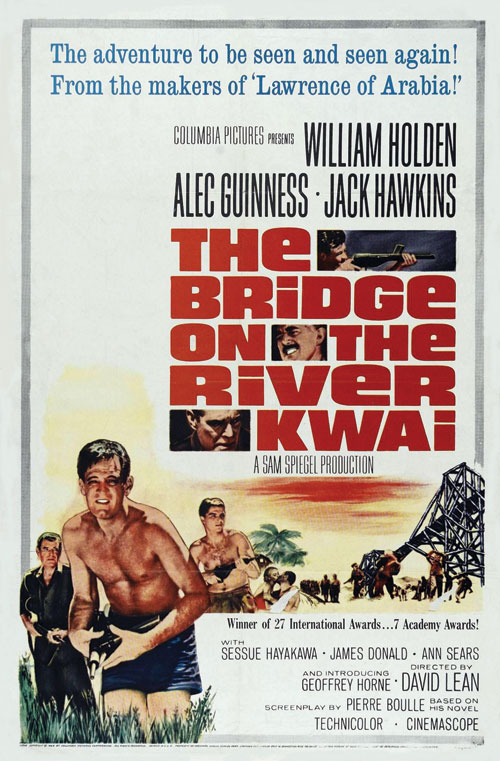
Commanders in Conflict
The outline of the plot is easy to describe. A company of British soldiers, under the command of the career officer Colonel Nicholson, a punctilious man beloved by his soldiers, and "a bore" according to director David Lean, has led his men into the Japanese camp, whistling what came to be the catchiest film tune of all time, and full of high morale. He has done so at the orders of his own army, as part of a deal with the Japanese.
Meanwhile, the Japanese commander, Saito (played by one of the most intelligent and sensitive actors I have ever seen, Sessue Hayakawa), is in charge of building a bridge to transport Japanese men and materials across the River Kwai. The work is behind schedule; his prisoners are sick and demoralized; his engineer is incompetent. He must build the bridge, and he needs all the labor he can command. That must include the English officers.
When Nicholson points out to him that the Geneva Convention expressly forbids the degradation of officers to manual laborers—and of course, the British colonel would have a well-thumbed copy of it in his pocket and would suggest a Japanese translation if it were necessary—Saito slaps him in the face. The conflict grows more tense, and eventually Nicholson and the other officers are all sentenced to tin-roofed "ovens," to broil in the jungle heat till they should come to their senses. Saito has said that they must understand that from the moment they entered the camp, they had ceased to be soldiers. But Nicholson's aim is to have them be soldiers to the end.
Who will concede? The colonel, with his rule book and his unflappable British ways? "This is not a game of cricket!" cries Saito. "I hate the British! You are defeated, but you have no shame!" Or will it be the beleaguered Saito, a proud man desperately trying to save face, even while he sees the evidence of his failure?
Building & Blowing Up
And there are other players, other points of view. There is the doctor, a man of flat common sense, who asks Nicholson whether it is not, well, treasonous to build a better bridge than the Japanese could have built themselves. Nicholson looks upon him as if he were speaking nonsense. "You have a lot to learn about the army," he says. He is looking toward the future, when the natives of that land will see the bridge and will remember who it was who built it—British men, even British prisoners.
The Japanese commander is not the only one who cannot stand the British. One of the prisoners is an American seaman, Shears (William Holden), who, as we learn later, has been impersonating an officer to gain a little better treatment. "Be happy in your work," he snarls, repeating one of Saito's favorite sayings. He is a cynic, dyed in the grain. He hates Saito and holds Nicholson in contempt. Somehow, he manages to escape and make his way through the jungle to a comfortable British encampment by the sea.
But the British have found him out and have worked out an arrangement with the American navy to have Shears assigned to a British demolition squad, with the slick code name "Force Three-One-Six." The squad is in the command of a Major Warden (Jack Hawkins), whose peacetime work is as a college don. Warden and Shears and two other men are to work their way back to the Kwai and blow up the bridge, preferably when the first munitions train is crossing it. For Warden, Shears says, the whole thing—the strategy, the demolition—is an intellectual game. When Warden hurts his leg and blood poisoning threatens to set in, he commands the American to go on and blow up the bridge without him.
Shears refuses, but not because he is kind. "There's a stench of death about you," he says. "You and Colonel Nicholson, you're two of a kind, crazy with courage. For what? How to die like a gentleman, how to die by the rules—when the only important thing is how to live like a human being!"
Thus it is that a British don, with a young Canadian lieutenant whom the Burmese carrier-girls love (Geoffrey Horne) and an American who says he does not believe in a thing they are doing, is going to try to destroy the bridge that the triumphant British officer Nicholson will have accomplished, while the British doctor (James Donald) looks upon both Nicholson's resistance to Saito and his building of the bridge as inexplicable.
Surprising Us into Humanity
David Lean understood that the film was not simply about war, but about human beings at war, and in this regard Kwai is much more like All Quiet on the Western Front (1930) than it is like a patriotic, flag-waving thriller such as The Guns of Navarone (1961). But it is not sentimental in the slightest. We listen to the musings of Nicholson, a man who has lived all his life in the service, with no real home and no family, wondering whether it was all worth it, as he leans out over the bridge on the last quiet night. We do not see his face, but rather that of Colonel Saito, his face and his hands, as every word of the Englishman, strangely incapable of imagining what his erstwhile opponent feels, strikes home, and we feel the enemy's loneliness and humiliation.
Such feelings are powerful, and not at all predictable; Lean surprises us into humanity. We see the final face-to-face confrontation of Nicholson and Shears: the British officer in shock, the American filled with a murderous rage, as each cries to the other, "You!" The Burmese girls speak to us with their looks as Warden tries to excuse himself, saying that he had to do it, he had to fire the shells that exploded on the far side of the river—and what those shells helped to do, you must watch the film to find out.
I have never seen a David Lean film that I did not admire. His Great Expectations (1946) wins my vote for the best film adaptation of Dickens, and it features a young Alec Guinness himself, in his first screen role, as Pip's best friend and confidant, Herbert Pocket. Lean's Doctor Zhivago (1965) may well be better than Pasternak's acclaimed novel, and its epic sweep is magnificent.
Lean was a hard-drinking, foul-mouthed, obnoxious man, and yet somehow the humanity in him always wins through, and we are made to see and feel—whether we like it or not, and sometimes we do not like it—the contradictions in that sad and terrible and wondrous creature, man. In the ancillary features of his art—cinematography, music, plot design, pacing—he is faultless.
See The Bridge on the River Kwai and consider that that was the sort of thing one of the major American networks put on television year after year. In some ways, we are as far from the world of my boyhood as the prison camp in Burma was. But that observation is for another film, and another article.
Anthony EsolenPhD, is a Distinguished Professor at Thales College and the author of over thirty books and many articles in both scholarly and general interest journals. A senior editor of Touchstone: A Journal of Mere Christianity, Dr. Esolen is known for his elegant essays on the faith and for his clear social commentaries. In addition to Salvo, his articles appear regularly in Touchstone, Crisis, First Things, Inside the Vatican, Public Discourse, Magnificat, Chronicles and in his own online literary magazine, Word & Song.
Get Salvo in your inbox! This article originally appeared in Salvo, Issue #61, Summer 2022 Copyright © 2026 Salvo | www.salvomag.com https://salvomag.com/article/salvo61/embattled-humanity


