
Joseph Mankiewicz's People Will Talk
Professor Elwell (Hume Cronyn), a little man in more ways than one, has hired a detective to get dirt on his fellow professor in a medical school. Since these were the years before the internet and social media, envy and vindictiveness had to proceed along slower and more human lines, such as face-to-face conversation. So, even though this most punctual of academics will be late for class, he invites a sudden visitor into his office. She is a beak-nosed lady (Margaret Hamilton, best known as the Wicked Witch of the West) who seems prime for spite and slander. She is also wary of gossip against herself, as slanderers often are.
"If I come in, does the door get closed?" she asks.
"Naturally," says Professor Elwell.
"Then I don't come in."
"Why not?"
"You know why not. You're grown up."
"My dear Mrs. Pickett," the professor begins, but she cuts him off.
"Miss Pickett, and don't butter me up!"
"I have conducted my affairs behind closed doors for twenty years," says the professor.
"Not with me."
He looks her over with patient disdain. "You overestimate both of us," he says.
Mysterious Pasts
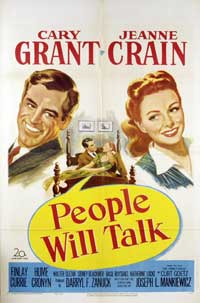
That is from the opening scene in Joseph L. Mankiewicz's subtle morality play, People Will Talk (1951). Mankiewicz was a man of the free-speech left, and it is easy to suppose that he was thinking of the backroom whispering campaigns against fellow directors and actors in the heyday of the House Un-American Activities Committee. Senator Joseph McCarthy, who accused (correctly, as it turned out) several high-ranking members of President Truman's treasury and state departments of being Soviet agents, had only recently burst upon the national scene.
Yet People Will Talk is in many ways a profoundly conservative film, affirming the goodness of the most fundamental human relations, as against both materialism and bureaucratic management. The object of Professor Elwell's envy is Dr. Noah Praetorius (Cary Grant), an immensely popular teacher, the conductor of the school's choir and orchestra, and the originator of a new clinic for a more human practice of medicine.
But nobody knows a thing about Dr. Praetorius's past. Giving opportunity for suspicious minds, he is followed, everywhere he goes, by a fearfully large and taciturn old gentleman, Mr. Shunderson (the wonderful Finlay Currie; see him as Balthasar in Ben-Hur, and as Abel Magwitch in David Lean's Great Expectations), given the unflattering nickname The Bat. Shunderson has no job, not even that of manservant. Dr. Praetorius says only that he is his friend, and that it is nobody's business why he stays at his side. Professor Elwell seeks to get at Dr. Praetorius through Shunderson.
Problematic Present
Meanwhile, a young female student, Deborah Higgins (Jeanne Crain), has fallen in love with Dr. Praetorius, but she, too, has a problem. When she faints in class—a cadaver of a young and beautiful woman lies on the table—she ends up being Dr. Praetorius's patient. She learns to her shame and dismay that she did not faint because she saw a dead body. She fainted because she is with child. The father was a man she hardly knew, whom she thought she loved, but who was killed soon afterward in the Korean War.
Her own father (Sidney Blackmer) is gentle, intelligent, morally upright, and proud of her as his only real accomplishment in life. Otherwise, he has failed at everything he has set his hand to, so that he and she have had to live as wards on her uncle's farm. The uncle makes his brother and niece feel their dependency and inadequacy. Miss Higgins believes that it would destroy her father if he should find out about her moral lapse. In despair, she tries to take her own life.
Jeanne Crain was the perfect choice for the role, feminine to the fingertips, and possessed of a quiet moral strength. She did not have much to pretend. She was politically conservative and a devout Catholic. She left her career in Hollywood in 1961 to devote herself fully to her family of seven children. Her marriage of 58 years ended with her husband's death in 2003; she died of a heart attack several weeks later. You may see her also in the title role of the light-skinned African American nurse in Pinky (1949), and as the eldest daughter in the robustly pro-marriage and child-affirming Cheaper by the Dozen (1950). We can believe that she would fall for Dr. Praetorius, and Cary Grant has that characteristic touch of boyishness and mischief that makes responsibility sweet.
Not Embarrassed by Faith
From what I have said, it might appear that People Will Talk skates on the edge of darkness. If it does so, it executes a perfect figure-8. The film is impressively bright and human, a story of love, gratitude, mercy, and compassion. Let me illustrate. Professor Elwell learns through his detective that Dr. Praetorius had long practiced medicine in a downstate village called Goose Creek. There should be no problem with that, except that Dr. Praetorius withheld from the people the fact that he was a doctor. He earned his living as a butcher, while quickly gaining a reputation as a miracle worker, a kind of faith healer. Miss Pickett, Elwell's informant (she wants a well-paying job), says that Dr. Praetorius talked her mother back from the point of death four times.
"And how old is your mother?" asks Elwell.
"She says she's 103," says Miss Pickett, "but I know for a fact she's not a day under 108."
Why would Dr. Praetorius set up such a subterfuge? When Elwell accuses him of being a quack, Praetorius replies, justly, that he has all the official qualifications of a medical doctor, which a quack does not. "I made sick people well!" he says. Of course, faith played a great part in his doctoring, nor is he embarrassed to admit it. "And as to the willingness of those so-called ignorant and backward people to rely upon the curative powers of faith, and possibly miracles too," he says to Elwell, "I consider faith, properly injected into a patient, as effective in maintaining life as adrenaline. And the belief in miracles has been the difference between living and dying as often as any surgeon's scalpel."
Dr. Praetorius has set his face like flint against the mechanization of medicine, and that is why, in his new clinic, patients are fed when they are hungry, rather than on a schedule, and they get to sleep uninterrupted by the regularities of the nurse's daily routine.
Who is this Shunderson, who can send an angry dog whimpering and running away just by staring down at him from his great height? "The dog is frightened and unhappy," he says, and the next time we see the collie, he is at Shunderson's side, loyal and content. What happens to Miss Higgins and her baby? What will Dr. Praetorius do to spare her and her poor father?
Dear reader, you will have to watch the film to learn the details. I assume that you can guess that Professor Elwell will fail in his soft-spoken, precisian, and hypocritical attack. But how it happens, quietly, even humorously, without the harsh, grim, and angry theatrics that vitiate films in our day, I cannot reveal, though I will say that if you were given a hundred years, you would never guess the secret of Mr. Shunderson.
The final scene is one of pure innocence and joy, as Dr. Praetorius leads his orchestra in a rousing version of that old college song Gaudeamus Igitur, and a woman in the audience, sitting beside her father, feels the child within her stir for the first time.
People Will Talk could not be made now. It is too pure. Some poor shadow of it could surely be made. For spite and slander we will always have with us.
Anthony EsolenPhD, is a Distinguished Professor at Thales College and the author of over thirty books and many articles in both scholarly and general interest journals. A senior editor of Touchstone: A Journal of Mere Christianity, Dr. Esolen is known for his elegant essays on the faith and for his clear social commentaries. In addition to Salvo, his articles appear regularly in Touchstone, Crisis, First Things, Inside the Vatican, Public Discourse, Magnificat, Chronicles and in his own online literary magazine, Word & Song.
Get Salvo in your inbox! This article originally appeared in Salvo, Issue #56, Spring 2021 Copyright © 2026 Salvo | www.salvomag.com https://salvomag.com/article/salvo56/bright-human


