
William Wellman's Battleground
Whenever I say that the last century has been impoverished in the arts, the first objection I meet is that I've fallen for an illusion. The argument is thus: Most of the art in any period is trash. We sift through it, so that what is great endures, and we forget the rest. The art of our time is no different. We just haven't yet done the sifting.
My first reply is to deny the premise. Most of the art in any period is not trash. Most of it, like the handicrafts in any healthy culture, ranges from the workmanlike to the superb, before you get to the masterpieces.
But my second reply is to note the disappearance of whole genres of art. It is not that current poets write poor epics, odes, narratives, hymns, and dramatic monologues. They do not write them at all. The art has shriveled up. Even the new art that the twentieth century brought to us, the cinema, has dwindled. Many types of movies cannot now be made.
Part of this is attributable to the demise of the studio system, which gave people the chance to tell stories that were not going to be lavish and glittering with stars, but rather were understated and human. But part of it is that no one would tell those stories now. No one has the touch or the taste for it, the warm desire to portray human beings as they are.
Ordinary Enlisted Men
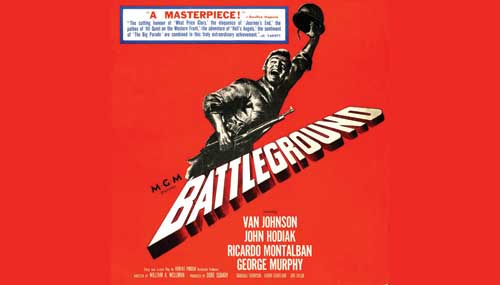
That is the genius of William Wellman's 1949 film Battleground, which describes the fortunes of a platoon of men in the 101st Airborne, as they endure a bitter winter in the region of Bastogne, Belgium, caught by the last desperate Nazi thrust in World War II. The movie is not candy. We don't have a lineup of he-men with dash and daring, stealing the show from the war, as in the edge-of-the-seat thriller, The Great Escape (1963). We don't get the archetypal warrior and general, as in Patton (1970). We don't have dubious battles on the high seas, as in The Sands of Iwo Jima (1949).
Instead we get the ordinary enlisted man: no one higher than a sergeant plays any important role in the film. What moves that man? What does he talk about? What does he think about? What does he long for? Who are his friends? What does it really mean for him to fight? Why is he there at all, in Luxembourg or Belgium (he isn't sure), short on ammunition, short on rations, out of gasoline for the tanks; digging a foxhole with his small collapsible spade, caught in a wintry fog and not knowing whether the Germans are behind him or before him or all around?
Private Holley (Van Johnson, perfect for the role) is a big cheerful fellow who thinks of having a good time with a Belgian girl in Bastogne (Darlene Darcel), and frying in his helmet the eggs he stole from her chicken coop. But we see his gradual change, from rascal to quiet hero, as he learns self-denial, without words, from the deaths of a couple of his friends.
Private Layton (Marshall Thompson, later known as the African doctor in the television series Daktari) is a fresh-faced boy newly assigned to the platoon, who at first has no friends and cannot even find a spare cot to sleep on, but the war slowly and surely binds him to the other men.
Private Jarvess (John Hodiak) is the real thinker among them, sour, morose, somewhat cynical, but brave and loyal; he is the only one who can speak French and a little bit of German. He gets newspapers from his hometown of Sedalia, Missouri. It seems his wife knows more about what the Germans and the Americans are doing around Bastogne than he does.
The Biggest Club in the Army
All through the film, we see moments of revelation, of moral change, without fireworks. Take the boy Layton. In his first real action, he sees Holley break from their holes in the snow drifts to cut behind German attackers and take them out. He follows. "I'm with you, Holley," he says.
Why did he go?
"I thought he was running away," he says later on to the hard-bitten Jarvess. "That's why I went after him."
"How do you know what Holley was thinking?" says Jarvess. "How do you know if he was thinking at all? Things just happen, then afterwards you try to figure out why you acted the way you did."
Layton drops his eyes. "I know why I ran. I was scared to death."
"You just joined the biggest club in the army," says Jarvess. "Everybody belongs."
That's no anti-war sentiment; just the plain truth. And Layton grows into something like courage, as he grows into friendships that his world back home cannot imagine.
Like Falling Asleep
Holley himself, who for the first part of the film plays the buffoon, is thrust into a position of responsibility when his sergeant is carried off the field. Except for that, he would not have made that dangerous run—and except for the death of a friend, a good-natured Spanish American (Ricardo Montalban).
Roderigues, from Los Angeles, had never walked in snow before and could hardly contain his boyish glee. We see him posing as a big-league pitcher, hurling snowballs at another fellow batting at them with a tree limb. But bombs burst upon them from the air, and the men have to scurry. Roderigues, wounded, crawls under an abandoned tank, covering up the space with snow. Many hours later, Holley returns to the tank, which has somehow survived the bombing without a scratch. They dig away the snow frantically, and come upon the man's hand, lifeless, and then his face.
"They say it's like falling asleep," says one of the soldiers, as Holley looks on. No more words need be said.
Shredded Boots & Fortitude
With a single deliberate move of the camera, Wellman says more than other directors say with a hundred gunshots and a thousand words. The chief of the company, Sergeant Kinnie (James Whitmore), a constant chewer of tobacco, is a stoical sort, resigned to the hardship, good-humored and weary. He stumps along on half-dead feet in shredded and flopping boots. When a chaplain (Leon Ames) comes by to lead the men in prayer and to encourage them by declaring that what they are doing is necessary to free millions of people from the slavery that the Nazis would impose, we see the boots of that man of God, and they, too, are in shreds. Those shreds say, "Men, I am one of you."
It would be easy to give in. A German officer tries to lure the men into surrender, saying that it is their only chance to save their lives, not to mention the civilians remaining in Bastogne whom they have met—who will not survive the next aerial assault.
Kinnie thinks for a moment or two. The German may be right, and not bluffing. Then his eyes harden. "Nuts," he says, and spits out a gob of tobacco. When he and his men are hemmed in, and they must fight to the death with bayonets at the ready, he falls upon one of the enemy, flat on the snow. We do not see the gore. We see the bayonet-thrust from above, and Kinnie's face as he pauses again—and spits.
Friendship the Key
A long time ago, I taught alongside a man who told me that despite all the horror, he never felt so alive again as he felt when he was an American soldier fighting on German territory. It cannot have been mere neural excitation. Friendship is the key. In the final scene, while the more celebrated airmen ride by in jeeps and tanks, Sergeant Kinnie, who has received his new orders, is left alone on the other side of the road, he and his stumps for feet. He tells the men to get up again, and has them turn away from Bastogne, back to the misery.
"Oh, no," says Holley.
"About face!" then cries the sergeant, with a very slight gleam in his eye. They are being relieved after all.
It brings Holley back to his old good cheer. They march.
"Hey, Kinnie," he hollers. "What ever happened to Jody?"
Kinnie seems not to hear, yelling at them for being slow. "What do you want, these guys to think you're a bunch of WACS?" They pick up their feet and march, as Kinnie sings out and they give the refrain.
"Your baby was lonely, as lonely as could be!"
"Till Jody provided company!"
"Ain't it great to have a pal—"
"Who works so hard to keep up morale!"
"Sound off!"
"One, two."
"Sound off!"
"Three, four."
"Cadence count!"
"One, two, three, four, one, two—three, four!"
Underrated Director
If you want a movie about ordinary men, real men and not peacock-actors, doing what ordinary men were called to do, Battleground is it. Nor should you overlook other films by the underrated William Wellman: Goodbye, My Lady, for instance, one of the finest boy-to-man movies Hollywood ever made.
Anthony EsolenPhD, is a Distinguished Professor at Thales College and the author of over thirty books and many articles in both scholarly and general interest journals. A senior editor of Touchstone: A Journal of Mere Christianity, Dr. Esolen is known for his elegant essays on the faith and for his clear social commentaries. In addition to Salvo, his articles appear regularly in Touchstone, Crisis, First Things, Inside the Vatican, Public Discourse, Magnificat, Chronicles and in his own online literary magazine, Word & Song.
Get Salvo in your inbox! This article originally appeared in Salvo, Issue #55, Winter 2020 Copyright © 2026 Salvo | www.salvomag.com https://salvomag.com/article/salvo55/real-men-at-war


