
Nathaniel Hawthorne’s The Scarlet Letter
In the digital age, platforms that could serve to convey knowledge have become the public pillories. Take for example one of the most popular authors of recent times. J. K. Rowling has suffered smears, attacks, and threats for upholding biological truth about women and the importance of guarding gender distinctions in public life. She defends women athletes who feel threatened when men claiming to be women are allowed into their locker rooms. She supports parents who make the same protest regarding school restrooms. Rowling’s accusers have been so ruthless that The Free Press produced an entire podcast series on “The Witch Trials of J. K. Rowling.” Public shaming, however, is nothing new.
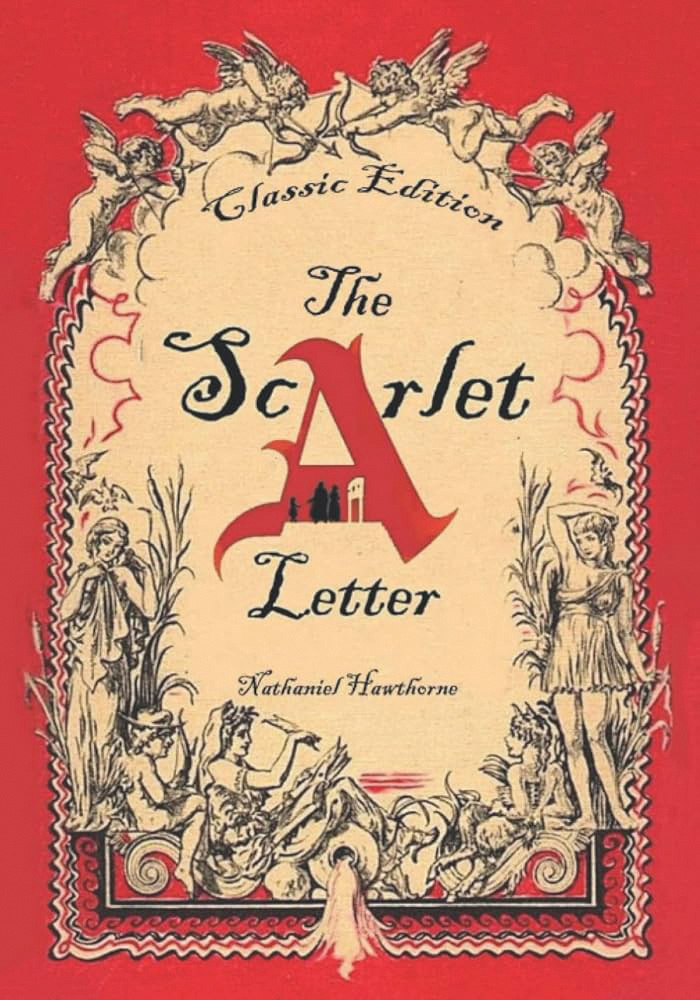
Set in the 1640s, The Scarlet Letter tells the story of Hester Prynne, a woman found guilty of adultery, forced to stand on a scaffold with her infant in her arms, and condemned to wear a scarlet letter “A” sewn onto her bodice. Before she arrives to stand on the platform for all of Boston to judge, one woman tells a group of female spectators that if they were in charge of the sentencing instead of Boston’s magistrates, Hester would not have been so lightly judged. Indeed, one woman would have her branded with a hot iron applied to her forehead, while another declares, “she ought to die.” Hester’s only advocate, holding a baby of her own, responds, “let her cover the mark as she will, the pang of it will be always in her heart.”
Above the vitriol, Hester dominates the scaffold, standing tall and elegant with flowing dark hair. In all ways she appears a lady, dignified and graceful. She holds her baby on her arm, exposing the scarlet “A” she herself has made of fine cloth and embroidered with gold thread. Artistically executed and striking, it actually seems an appropriate decoration for her gown, though clearly not in line with the colonial sumptuary laws that limited expenditures on personal possessions deemed extravagant.
A Multitude of Judges
When the magistrates demand that Hester identify her partner in adultery, she refuses. Those magistrates include the colonial governor Bellingham, the elderly Reverend Wilson, and the young Reverend Dimmesdale, Hester’s pastor. Though calling them good men, the narrator says it would have been difficult to find three men “less capable of sitting in judgment on an erring woman’s heart.” Only one of them, Dimmesdale, expresses that it is wrong to force a woman “to lay open her heart’s secrets in such broad daylight, and in the presence of so great a multitude.” Yet, when pressed publicly by both the governor and the elder clergyman, he does say to Hester, “thou seest the accountability under which I labor . . . I charge thee to speak out the name of thy fellow-sinner and fellow-sufferer!”
Dimmesdale has a reputation for eloquence and faith. His parishioners and colleagues perceive him as having both “a nervous sensibility and a vast power of self-restraint.” When he speaks, they hear “the speech of an angel.” However, he also seems uneasy. While the spectators cannot imagine anyone resisting his words, neither Hester nor her illicit lover, Hester remains silent. When Reverend Wilson demands that she confess her partner’s name and suggests her repentance “may avail to take the scarlet letter off thy breast,” Hester responds, not to Wilson, but to her own pastor, “It is too deeply branded . . . would that I might endure his agony as well as mine.” In that response, Dimmesdale must hear the words of a soul more courageous than himself. He is the unnamed father.
Hester remains otherwise silent. She appears indifferent, though the narrator fills in what the spectators cannot see: “she felt, at moments, as if she must needs shriek out with the full power of her lungs, and cast herself from the scaffold down upon the ground, or else go mad at once.”
The Prosecutor
One spectator has been far from indifferent. Even before her questioning, he declares Hester’s sentence to be wise, believing the scarlet letter should even be engraved on her tombstone. He declares of the unidentified partner, “he will be known!” Hester, not truly indifferent herself, recognizes the man. She even regards her situation on the scaffold as a temporary protection from speaking to him. He is her husband who failed to arrive in the colony after sending his wife ahead. Only his possible death at sea saved Hester from the death penalty.
A physician, he calls himself Roger Chillingworth to hide the fact that he is Hester’s husband. He sent her to Boston while he settled business in Britain, but Indians captured him upon his return and held him for ransom. Enraged by her infidelity, Chillingworth goes to her cell to attend to her agitation and demand that she identify the child’s father. When she refuses, he swears to uncover the truth despite his own callousness regarding his absence up until this point.
Defying Cancel Culture
According to historian Will Durant, one of the four pillars of any culture is a unifying moral code which discourages socially damaging behavior. In seventeenth-century Boston, Christian beliefs defined that code. In The Scarlet Letter, Hawthorne critiques the excesses of the Puritans’ shaming without critiquing, or even disapproving of, their Christian moral code. For this, the “New Puritans” of wokism, as author Andrew Doyle calls them, would likely strike Hawthorne as excessive as well.
Though the voices of cancellation demand apologies, they do not forgive. Chillingworth has a right to be angry, but the extremes to which he takes his inquiries are strikingly similar to those taken by often anonymous shamers online. The young mother watching Hester on the scaffold had empathy for her, but the people who rage for empathy today show none, instead using electronic scaffolds to destroy reputations and lives just as Chillingworth and the other spectators strive to do.
But with Hester Prynne, they failed. Like Rowling (whose books have suffered no dip in sales—her attackers have only managed to polarize the two sides of the transgender issue), Hester endures with equanimity the attacks and humiliation. Having acknowledged her sin, she endures the punishment of an adulteress, but she refuses to condemn another. Instead of succumbing to scolds, she goes on to ply her trade as a seamstress and become a successful contributor to Boston society. Following a very brief stay in prison, she lives alone with her daughter in a cottage on the outskirts of town, and the attitude of Boston’s citizenry toward her changes over the years. Though they did not forget her adultery, Puritan cancel culture did not cancel her.
The Scarlet Letter shows how to resist and overcome cancellation by refusing to submit to it. If every student assigned the novel had read and understood it, the hypocrisy and extremism of cancel culture might not have progressed into the disease of souls it has become. As it is, we have a preponderance of social ills on so-called “social” and other media.
While Hester’s sin is one Judeo-Christian civilization has condemned since the times of Moses, it is also the sin for which Christ famously forgave another woman caught in adultery. Instead of shaming or prosecuting her, he delivered her from the murderous hands of her accusers and simply commanded her to “go and sin no more.”
Rick Reedis a retired secondary teacher of English and philosophy. For forty years he challenged students to dive deep into the classics of the Western canon, to think and write analytically, and to find the cultural constants reflected throughout that literature, art, and thought.
Get Salvo in your inbox! This article originally appeared in Salvo, Issue #71, Winter 2024 Copyright © 2026 Salvo | www.salvomag.com https://salvomag.com/article/salvo71/above-the-mob


