
Fourteen Hours
About to Jump
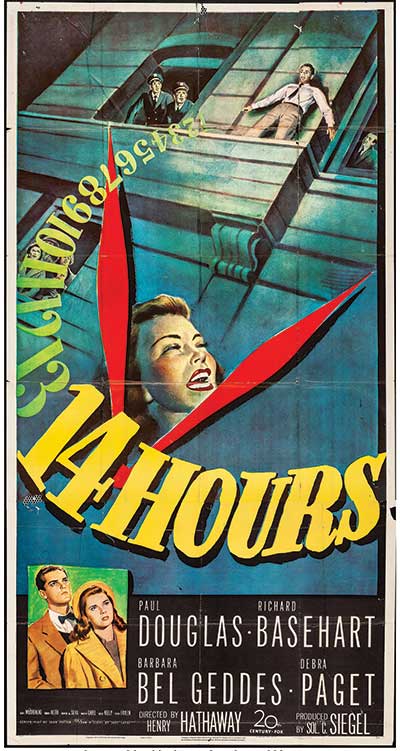
Thoreau said that most men lead lives of quiet desperation. It was the sort of exaggeration he was given to; perhaps his brooding solitariness was the cause. It’s easy to see how you can be solitary in a shack on the banks of Walden Pond; not so easy if you live in Manhattan. Yet the loneliness of the city is deeper than the loneliness of the woods. On the pond, you have to go fishing to get your supper, and the feeling that you share the world with other living things, with creatures that do not threaten you but go about their daily business, can soothe the heart. But if you are in the city, the works of man are everywhere, and so are people—in competition, at strife, always comparing themselves with one another, even when they look straight ahead and might as well consign you to a planet a million light years away. Then you might say what the young Robert Cosick (Richard Basehart) says in Fourteen Hours. It’s all a bad job, this world. What’s the use?
So he is on the ledge, but nervous about what he has decided to do, when an ordinary beat-walking cop, Charlie Dunnigan (Paul Douglas) catches sight of him and phones in to headquarters that there’s a “jumper.” He then rushes up to the room in the building, leans out of the window, straddles the ledge, and talks to Cosick, asks him what’s bothering him.
“Life stinks and you know it!” Cosick cries out. “It’s a rat race, a rat race!” Now, Officer Dunnigan has no idyllic life, as we’ve begun to see. He does have a family he loves, but he’s a middle-aged man going nowhere in his job, and throughout the film he is treated by his superiors with mingled annoyance and impatience. And what about all the people gathering in the streets below? Some are there for the spectacle. Some are taking bets. A woman in a lawyer’s office sees him from across the way (the actress is Grace Kelly, doing a cameo in her first film). She’s there to sign divorce papers.
Cosick’s own mother and father, we learn, are separated. The mother (Agnes Moorehead, who made a career of playing harridans, though she actually liked children and always brought a Bible with her to the set) has long poisoned the boy’s mind against his weak-willed father (Robert Keith, the father of the soft-spoken, tough-guy actor Brian Keith). In one scene, it’s the mother herself who nearly causes her son to jump. Meanwhile, we learn that Cosick has a girlfriend whom he loves, but they have broken up, or at least he has given up hope, and it is all Officer Dunnigan can do to wring from the mother the name of this girl, Virginia (Barbara Bel Geddes).
Tensions
Henry Hathaway, the director of Fourteen Hours, did not go in much for sentiment, and I think he is wise to keep it at a distance here. The main thing that Cosick needs is somebody to talk to, and he’s got that in Dunnigan, the craggy middle-aged policeman. Their conversation does not turn upon big ideas. It turns upon the ordinary stuff of life.
Sure, there are a lot of bad things, but some things in life are okay, says Dunnigan,like going fishing on Sheepshead Bay, as he offers to do with Cosick. In part, he is stalling for time, as the police have converged upon the hotel. Some of them will be risking their necks trying to nab him from above; others seek a way to catch him in a net from one of the rooms below; and the more energetically and obviously they work, the more suspicious Cosick becomes, and that begins to compromise his trust in Dunnigan, the only man he will talk to—the only man, at least, until his father arrives, pleading, apologetic, knowing that he hasn’t been much of a father, but knowing also that he is not the coldhearted creature that his estranged wife has made him out to be.
For all the focus on the young man, the cop, and the ledge (and you really do feel the strain of the situation; Basehart spent 500 hours in that standing position, and though he is young and still fresh-faced, the exertion tells upon his countenance), Hathaway does relieve us occasionally by a lightly touched side plot or two. The woman in the lawyer’s office—what is she going to do? And there’s a young stockroom clerk, Danny (Jeffrey Hunter, in his first movie role), who has an eye for Ruth, one of the girls in the office, and they are there too, in the street, looking on. And we have the tension between Dunnigan and the police chief, which sometimes flares up into outright opposition, so that we are made to feel that Dunnigan is putting his livelihood at risk.
Unsteady Ground
Fourteen Hours is based upon a real event. In 1938, a young bank clerk named John William Warde spent twelve hours on a very narrow ledge outside the seventeenth story of the Gotham Hotel. He, too, was befriended by a traffic cop, and he was about to enter the hotel room again, because the cop promised him that he could have privacy there and could still jump if he changed his mind. But a thoughtless and selfish photographer snapped his picture, and Warde, feeling betrayed, ran to the window again and leapt to his death.
In Fourteen Hours, Officer Dunnigan must walk a tightrope between winning Cosick’s trust and cooperating with the others who would save his life by hook or by crook. What happens at the end of the film I will not reveal. But we are gripped all throughout by the stories, often given to us by a suggestion here or there, of human beings, some of them good and some of them bad, doing their own walk on unsteady ground. It is a film about Everyman. Without God, that unsteady ground is just a thin bit of stone.
Anthony EsolenPhD, is a Distinguished Professor at Thales College and the author of over thirty books and many articles in both scholarly and general interest journals. A senior editor of Touchstone: A Journal of Mere Christianity, Dr. Esolen is known for his elegant essays on the faith and for his clear social commentaries. In addition to Salvo, his articles appear regularly in Touchstone, Crisis, First Things, Inside the Vatican, Public Discourse, Magnificat, Chronicles and in his own online literary magazine, Word & Song.
Get Salvo in your inbox! This article originally appeared in Salvo, Issue #69, Summer 2024 Copyright © 2026 Salvo | www.salvomag.com https://salvomag.com/article/salvo69/life-on-the-edge


