
Alfred Hitchcock’s I Confess
There was a time, not so long ago, when people understood that certain human relationships are more important than civil law. I am not talking here about “attorney-client privilege,” which is a procedural ground rule to make the position of attorney possible and to ensure that the counsel you hire is yours and not someone else’s in your place. We move closer to the point with “doctor-patient privilege,” though what’s at stake there is not the relationship itself but the care of the body, which would be put in jeopardy if people had to fear that they would set themselves up for legal or financial attack when they call the doctor. We hit the mark precisely with the rule that a wife may not be compelled to testify against her husband. That is not because her testimony will likely be untrustworthy. It is that the relationship itself is sacred and must be held inviolable.
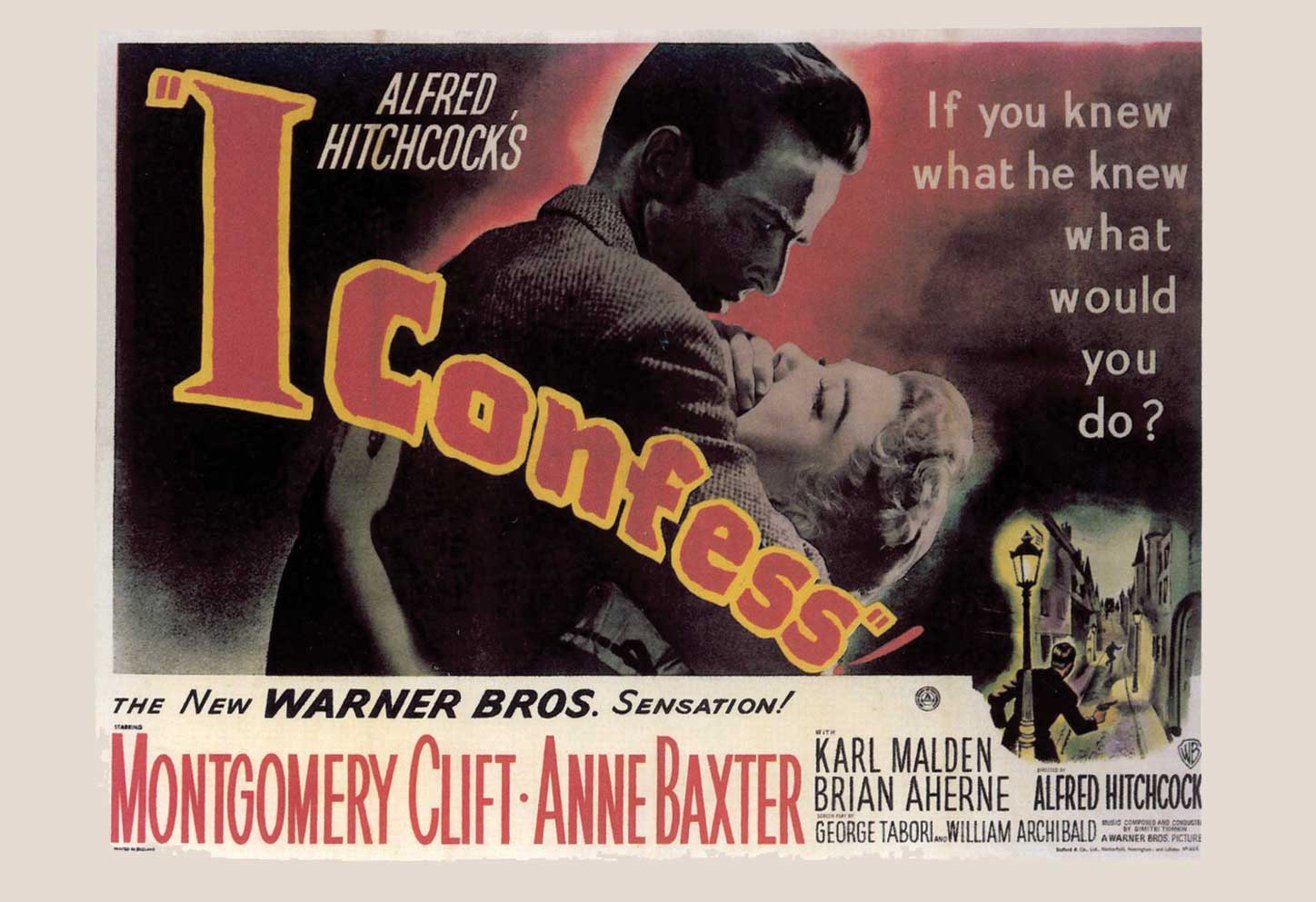
Then we come to the relationship between a penitent and his priest, one that Alfred Hitchcock illustrates in his drama of psychological pressure and painful honesty, I Confess (1953). What is the relationship to be protected here? It is not that between the penitent and the priest, since the two may hardly know one another. The priest stands for and speaks for God, and that alone is why the penitent seeks him out. There we have not only a relationship, but the prime relationship that founds all of human existence, as man is made by God for God; so that if we made that relationship subordinate to the civil law, it would be to reverse the order of ends, resulting in nonsense. If you make friends so that you can make money, you have not made friends, and what is your money for? And suppose we could dispense with the testimony of a priest by means of a machine that could read a man’s silent prayers. Such a thing would not only destroy prayer; it would destroy man.
A Killer & His Priest
You have to understand that the whole meaning of man is at stake if you are going to watch I Confess. The scene is Quebec City, where a German expatriate, Otto Keller (O. E. Hasse), works as a handyman at a church and rectory, along with his wife, Alma, who is the cook and cleaning lady. Alma is frail, and so Keller wants money so that she can cease working so hard. He attempts to rob a villain and blackmailer, a lawyer named Villette. But he ends up killing Villette instead, and that leads to the first scene in the film, when Keller goes to the church, and finds the young Father Michael Logan (Montgomery Clift). He is there late at night for troubled reasons of his own, as we will learn. Keller, who used a priest’s cassock as his disguise and shucked it on the way back from the killing, is clearly on the edge of insanity, and he asks Father Logan to hear his confession. Father Logan does not absolve him of his sin. He cannot unless Keller goes to the authorities. But Keller refuses to do that, and terror gets the better of him.
The next morning, Father Logan himself shows up at Villette’s residence, where a crowd has formed, for the body has been discovered. We suppose he is simply curious, but that is not so. He tells the police that he had an appointment that morning with Villette. We suppose that that is an innocent falsehood; we are wrong about that too. A married woman, Ruth Grandfort (Anne Baxter), also shows up, but Father Logan hustles her away, and the police detective, Inspector Larrue (Karl Malden), catches that suspicious action from the corner of his eye.
“We’re free,” says Father Logan to Ruth —and what that means, we do not yet know. It will turn out that Villette has been blackmailing Madame Grandfort, and that Father Logan, with whom she grew up and who was her first and perhaps only true love, is embroiled in a trouble she wishes to suppress. For though her husband is a good man, she is not in love with him, and she has told him so, frankly. Meanwhile, two young girls tell the inspector that they saw a priest leaving Villette’s house late on the previous night.
All the circumstantial evidence, including Keller’s own false testimony, points to Father Logan as the murderer. But of course, the seal of the confessional is his bond. He cannot reveal what he knows. It seems as if the innocent must bear the cross for the unrepentant sinner.
A Priest Resolved
Some critics, I’ve seen, complain about what they find implausible —that Father Logan did not simply come out and say, “I cannot tell you what I know, Inspector, because the duties of my work do not permit it.” But that would be to try to have things both ways, to keep the vow and to break the vow, and to expose the criminal. Hitchcock, a Roman Catholic, took for granted that his audience would understand: the priest may not hint that he knows more than he can tell; he may not lead the police by any suggestion; he may not, by word or action, give a single clue as to any facts regarding the person who committed the sin, or regarding the sin’s nature, manner, or motive. The silence must be absolute; he must not even say something like, “My silence must be absolute.” For he has, in a way, taken the penitent’s sin upon himself.
Madame Grandfort has made a similar sacrifice —and again, this is something that the same critics do not understand. When Logan came back from the Second World War, she was waiting for him, but he had determined to become a priest, and this was why she soon married, not for love but for comfort or security or disappointment. The marriage is not very happy; yet we sense that the last word on it has not been spoken. For she has been paying Villette blackmail money, not just to protect her reputation, but also to shield her husband. She has maintained the strictest silence about her love for Father Logan, and she has suffered for it.
Alfred Hitchcock is known as the master of suspense, of the psychological thriller, and of the unnerving visual shot. We have the pleasant and amiable and unnervingly talkative motel clerk, Norman Bates, in Psycho (1960), nervously chewing gum as he watches the car of the woman he has just murdered sink into the muddy pond. We have the silky sophisticated cynic, Bruno Antony, in Strangers on a Train (1951), sitting calmly in the stands at a tennis match, staring motionless at one of the players, his intended accomplice in murder, while the heads of everyone around him move back and forth with the flight of the tennis ball.
But nothing like that can happen in I Confess. Father Logan must not draw attention to himself, and he is the movie’s focus, rather than the murderer, Keller. Yet the occasional shot does convey the moral agony he undergoes. We see him, for example, walking down one of the streets of Quebec, but from a vantage high up on the roof of a church across the way, whose façade is surmounted by the sculpted figure of Christ carrying the cross with his Roman executioners roundabout. Father Logan too is like a sheep led to slaughter; he too is the suffering servant who did not open his lips against his tormentor. The understated brooding of Montgomery Clift is meant to cause us to wonder not so much what that person in that situation must be feeling, but how we ourselves might pray to God for the power to do the right thing, even as we know we will be misunderstood, even condemned for it, and not by cruel men, either, but by good and responsible men, by such pillars of the community as Inspector Larrue.
To Confess
The movie’s resolution includes a couple of surprises I will not reveal. But I will say that the title, I Confess, is deliberately ambiguous. Hitchcock knew it, and he supposed that many in the audience would know it, too. To confess, in Christian terms, is not, in the first instance, to tell your sins to someone, even to God, but to profess, and to do so before man and God. That is what Father Logan is doing in his painful silence and willingness to suffer —indeed, to be hanged for murder —if he is convicted. As for the secondary meaning, to confess your sins, the film begins and ends with a confessional scene, each time with some words missing that we might expect, and each time presenting us with words we might not expect. And Hitchcock knew how to end a film, too —with an end beyond which, in the context of this drama of souls hanging over the pit, it is impossible to go.
Anthony EsolenPhD, is a Distinguished Professor at Thales College and the author of over thirty books and many articles in both scholarly and general interest journals. A senior editor of Touchstone: A Journal of Mere Christianity, Dr. Esolen is known for his elegant essays on the faith and for his clear social commentaries. In addition to Salvo, his articles appear regularly in Touchstone, Crisis, First Things, Inside the Vatican, Public Discourse, Magnificat, Chronicles and in his own online literary magazine, Word & Song.
Get Salvo in your inbox! This article originally appeared in Salvo, Issue #68, Spring 2024 Copyright © 2026 Salvo | www.salvomag.com https://salvomag.com/article/salvo68/weights-of-confession


