
Ben-Hur
The Roman soldiers are leading a long train of slaves to the galleys, and one of them, a Jew from the princely family of Hur, is near to dying of thirst. When he tries to sip a little water from the dipper held out for the other prisoners, a soldier cries out, “Not for you,” and knocks it from his mouth.
A man has been watching the goings-on. We see his hands; they are young. We see the tools of the carpenter. He sets the tools down. We do not see him directly. The camera shows us what he sees. The music, by the magnificent Miklós Rózsa, tells us who he is. He is not intimidated by the Romans. He goes over to the young prince, who has fallen to his knees. He gives him water, letting him drink his fill, and as he does so he touches the man’s face and his hair.
“Hey, you!” cries the captain, but when he turns toward Jesus, ready to fling a threat or an insult his way, Jesus stands up and looks at him. Again, we do not see Jesus. We see instead the effect that seeing Jesus has on the captain. He suddenly looks abashed, embarrassed, doubtful of himself. It is as if he has seen, for the briefest moment, the purity of divine love, and felt, again for a moment, how like a worm he is; and that is not because he is especially wicked. In fact, he looks like the sort of rough-and-ready, middle-aged man you might find in a fire department. It is because he is man, unredeemed, full of himself and his responsibility, and therefore empty.
A Man of a Different Order
Many of my readers will recognize this scene from William Wyler’s Ben-Hur (1959), with Charlton Heston playing the title role of Judah Ben-Hur, a faithful Jew wrongly accused of an attempt on the Roman governor’s life; what makes matters immeasurably worse is that the accuser, Messala, knows very well that Judah, and his mother and his sister, who are also arrested and who are sent to an underground prison, are innocent.
Messala (Stephen Boyd) had been a family friend; he and Judah had grown up as boys together. But when Judah refuses to become an informant for Messala, to help him root out the insurrectionists among the Jews, the Roman shows his pride and vindictiveness. What is at stake, as Messala himself has said, is “an idea,” the idea of Rome, of universal rule by that mighty people who know how to bring order among peoples whether they like it or not. That Roman idea such as Messala conceives it, in every form it has assumed in the history of mankind—call it Moloch or Mammon or Leninism or the ghastly bio-technocracy among us aimed at making the world safe for perversion and automatism—is, as the novelist Lew Wallace perceived, incompatible with the Jewish faith and with any worship of Christ as the Son of God.
If you have seen Ben-Hur, I am recommending that you return to it with the admonition that it is far more subtle and penetrating, theologically, than you may have been led to suppose. We do not see the face of Christ, though the novel is subtitled “A Tale of the Christ,” but not because no actor could do him justice. The worthy men of Wakefield and York and countless other towns and villages across Europe, when they staged their boisterous cycles of plays to celebrate the feast of Corpus Christi, did not merely suggest Jesus. Hardly! At Wakefield, in the play on the Harrowing of Hell, the actor playing Jesus cries out in Latin, “Lift up your heads, ye gates, and let the King of glory enter in!” The devils behind the gate press against it to keep it shut, while the prophets and patriarchs are feeling a joyous anticipation, and when Jesus cries out for the third time, somebody behind the scenes—no doubt a locksmith—flips a lever and the spring-loaded gates open with a crash, to the sheer delight of children of all ages.
But those medieval people did not know what it was to be presented with the great lie, some sort of humanistic alternative to Jesus. It isn’t that their Jesus was tame, so much as that they had themselves taken up residence in the precincts of the divine, and they felt no distinction between a secular world and a sacred world. I don’t imply that they were all saintly—no reader of Dante, Boccaccio, Chaucer, or Villon would suppose that! But the divine was the only game in town. And that was not so by the time Lew Wallace wrote his novel in 1880, and certainly not by the time Wyler, a Jewish man, directed Ben-Hur.
Christ, as Wyler perceived, was not a different kind of Roman; the Jewish zealots, stung into vindictiveness by mistreatment, as was Judah’s old family servant Simonides (Sam Jaffe), maimed by the Romans when he would not reveal where the wealth of the house of Hur was concealed, were but a different kind of Roman. Even the worthy sheik Ilderim (the Welshman Hugh Griffiths won an Oscar for his scene-stealing performance), who stakes his magnificent white Arabians, driven by Judah in the greatest single sporting scene Hollywood ever filmed, against the black stallions of the Roman tribune Messala, is, after all, but another kind of Roman, a hater of Rome in practice but not at all in principle. Rome cannot cure leprosy. Rome cannot uproot sin from the human heart because Rome is built upon and by means of sin; and I am not saying that Rome is therefore particularly evil. Rome is human, all too human.
The Water & the Blood
We do not see the face of Christ, but we do see, at crucial moments in the film, and without a single character commenting upon it, the two great sacramental realities that are to wash us clean from sin, a far worse malady than mere leprosy. Those are water and blood.
Pay close attention, reader, to what Wyler has done. When Judah, after a long absence, returns home at the beginning of the movie, he dips his finger in the little water stoup that stands just outside the door. It is not an idle thing. It binds him, though he is a rich man of the world, to his Jewish forebears from many generations before. I have mentioned the drink of water that Jesus gives him. But where else is a galley slave, if not amidst the terrible waters of the sea? When Judah’s ship is going down in its battle against pirates in the Mediterranean, water fills up the hold, and the prisoners, chained to their oarlocks, try desperately to get free, and Wyler even shows us their hands extended high over their heads as they drown. But Judah, by a seemingly unaccountable act of mercy, had been unchained by the naval captain Quintus Arrius (Jack Hawkins), and we will see him, in his slave-tatters, on a scrap of wreckage, with his Roman taskmaster, whom he saves from suicide—”water, water everywhere,” as the poet says, “and not a drop to drink.”1 That mighty sea will thus be Judah’s salvation, and Arrius, in gratitude, will adopt him as his son.
What Judah encounters when he returns to Palestine, searching for his mother and his sister, is more than the vengeance he seeks against Messala; through the lovely and wise slave-girl Esther (Haya Harareet), who has loved him since she was a child, he encounters the person of Jesus. He has seen too much wickedness in the world to believe in teachings so pure—that is, until he encounters, from afar, the person. Who that person is, he does not know, and will not know, until he sees his face from a few feet away.
We do not see the face of Jesus, again, but Judah does. We see Judah’s face, and it strikes Judah that this Jesus is the same man who saved his life by giving him one cool drink of water. And now, as Jesus makes his agonizing way up the mount of the Skull-Place, Judah tries to repay the favor, but the water is knocked out of his hand.
The storm of that terrible day is going to come, we know, but it does not occur to you until you see it that it is going to be dominated by water, torrents of water, and then suddenly, as the music of Rózsa shifts mode and tempo, that same water that can destroy is like a new element in the world, washing everything clean, and we see the trickling blood from the cross mingling with it, as if to drown the world of wickedness and raise it new in a life that no Rome at that time, and no Rome ever to come, can conceive, much less provide.
Somehow, Wyler perceived what many a Christian has forgotten. The person of Jesus cannot be bound up in any ideological program, or any historical just-so tale, or any mere philosophy of life; Jesus is not Socrates, Zeno, Buddha, or Confucius. Those are men whose faces we might recognize, or forget, as the case may be. But the face of Jesus is of a different order entirely. May we all behold that face looking mercifully upon us. It is the face of our dearest friend and brother. It is the face of the Lord.
Note
1. From The Rime of the Ancient Mariner, by Samuel Taylor Coleridge (1798).
Jesus Reimagined
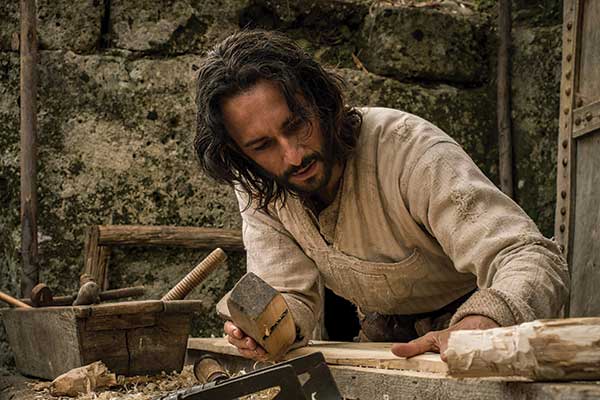
In 2016, Paramount Pictures released a re-adaptation of Wallace’s novel. Paramount’s Rob Moore described it as a new interpretation. The term is apropos, as the two films present remarkably different interpretations of the major characters. With his father deceased, Judah Ben-Hur 1959 is a God-fearing man and head of the house of Hur. Wise to the ways of man, he recognizes Rome as an affront to the God of his fathers. By contrast, Judah 2016 is more boyish; he’s content to let Rome be Rome, and his mother Miriam be head of the home. Instead of knowing his people’s history and trusting God, he asks, “If God is a God of love, why doesn’t he do right by the world?” Many plot points also differ. For example, instead of being inexplicably set free from the oarlock, Judah 2016 manages to free himself.
As for Messala, he plays a larger and more sympathetic role in 2016. Director Timur Bekmambetov told SlashFilm.com that this film is “not Ben-Hur’s story, it’s Ben-Hur and his brother’s story.” Messala lives for Rome and Rome’s power, but for this Messala, choosing Rome’s way of power isn’t bad per se; it’s just a different choice. In the end, Messala is healed and made new apart from any encounter with Jesus.
By far, the biggest difference lies in the different portrayals of Jesus. In Ben-Hur 2016, we do see his face, and we hear him speak. Although we see the crucifixion—a sight at which Judah 2016 is noticeably moved, perhaps even undone—the Jesus of Ben-Hur 2016 is mostly a figure of sound bite platitudes: God is love, and he made us to show his love. Hate and fear are lies that turn us away from each other and make us slaves. Love is our true nature, and we are to love our neighbor as ourselves. While Jesus 2016 has worthwhile things to say, scrappy Judah and Messala fend for themselves fairly well without him. In some ways they save each other; in other ways, each is the hero of his own story. “Jesus” changed a lot in 57 years.
Anthony EsolenPhD, is a Distinguished Professor at Thales College and the author of over thirty books and many articles in both scholarly and general interest journals. A senior editor of Touchstone: A Journal of Mere Christianity, Dr. Esolen is known for his elegant essays on the faith and for his clear social commentaries. In addition to Salvo, his articles appear regularly in Touchstone, Crisis, First Things, Inside the Vatican, Public Discourse, Magnificat, Chronicles and in his own online literary magazine, Word & Song.
Get Salvo in your inbox! This article originally appeared in Salvo, Issue #67, Winter 2023 Copyright © 2026 Salvo | www.salvomag.com https://salvomag.com/article/salvo67/a-tale-of-visitation


