
A Conversation with Erin Hawley About the Undoing of Roe v. Wade
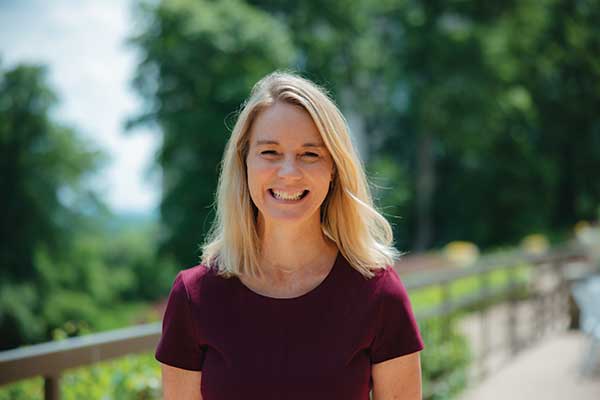
Erin Hawley is a graduate of Yale Law School and former law professor who clerked for Supreme Court Chief Justice John Roberts. She also happens to be the wife of U.S. Senator Josh Hawley (R, Missouri). When she took a job as senior counsel to the appellate team at the Alliance Defending Freedom in February 2021, she never imagined that a few months later she would be guiding their legal team through one of the most significant Supreme Court decisions in U.S. history—the case that would eventually lead to Roe v. Wade being overturned. The impact of that victory continues to reverberate in our culture, and in Erin’s view, the backstory of how it happened has God’s fingerprints all over it.
Could you give us a little background about what has formed your pro-life convictions and a short summary of the tactical maneuvering behind the Dobbs case?
I grew up in a Christian home with a really beautiful mom who was very good at teaching us about Scripture. I think the Bible is clear that unborn children are created, formed by, and valuable to God, even in their mother’s womb. And I had children. When you see an ultrasound, it becomes obvious when life begins. You can see the features of your child and hear the baby’s heartbeat. You just know and can see how intricately God has made this tiny person. And so, that visible depiction of the way in which God cares for unborn children was really motivating both to me and to my husband.
As for the Dobbs case, I’m sure many of your readers have been thinking about and praying for a reversal of the Roe v. Wade decision. And I think we really see how those prayers were answered in Dobbs. I say that for several reasons. To begin with, the case originated in Mississippi in 2018. The day after the state legislature passed a law restricting abortion, the [Jackson Women’s Health Organization] abortion facility got an injunction against the Mississippi law, even though that law is very modest. It only protected life at 15 weeks. Yet the lower court blocked it, and it went up to the Fifth Circuit Court of Appeals. The Fifth Circuit also blocked it.
At that point, Mississippi petitioned for certiorari. And then something really interesting happened. The case sat on the U.S. Supreme Court docket for nearly a year. That is something that really doesn’t ever happen. Usually, the Court is pretty expeditious in deciding whether it will hear a case. So you can speculate. Maybe one of the justices was writing a dissent from denial. Maybe the Court wasn’t going to take the case. Whatever was going on behind the scenes, during that time Justice Amy Coney Barrett was appointed to the Supreme Court and confirmed. In Barrett, we have a justice who is personally very pro-life and very committed to originalism and to the constitutional text, which nowhere contains any right to an abortion. We can’t look behind the curtain and know for sure, but we do know that after Justice Barrett’s confirmation, the Supreme Court granted certiorari—the process to review the case—which almost certainly would not have happened without her.
Similarly, the attorney general of Mississippi was newly elected and staunchly pro-life. She had appointed a new solicitor general who was also very pro-life and an experienced appellate advocate as well. At that point, the Mississippi attorney general, Lynn Fitch, and the solicitor general, Scott Stewart, had an important and consequential decision to make. They had to decide whether to ask the Supreme Court to overturn Roe. The petition to the Court had raised the issue, but it was really focused on the viability rule and not as much on overturning Roe.
Because I was working for the Alliance Defending Freedom, I was able to help their team with this. We strategized about how best to approach this case. We concluded that we just wanted to ask the justices to do what was right, and that was clearly to overturn Roe v. Wade. We knew the right to an abortion was nowhere to be found in the Constitution. We also knew that we would be arguing in front of the best Supreme Court for originalism and a faithful interpretation of the Constitution that had existed in a very long time. So Mississippi made the strategic call to ask the Supreme Court to overturn Roe.
But you would be amazed. You know, we think now that what happened in the Dobbs case was foreordained. But if you would have asked almost any appellate lawyer—certainly the ones in Washington, D.C., who were familiar with the Court—they would have told you that the Court is an incremental institution. They would have said it was a mistake to ask the Court to overturn Roe v. Wade. I had a debate with a Columbia law professor who served in the Reagan administration. He said he was generally sympathetic to the idea that Roe was wrong. But in November 2021, just a month before we made the oral argument, he said that the Supreme Court would never overturn it. So I’m really thankful that Mississippi had the courage of its conviction and decided to go for the bold win.
Some have speculated that abortion supporters decided it was better to “lose big” so they could use the decision to rally people to restore Roe politically. That seems to be exactly what is going on, and last fall’s midterm election results suggest it is working. How can we continue to engage the issue legally?
With the Dobbs decision, you do get the return of the issue to the states. So we have seen a number of states, including my home state of Missouri, that, on the same day Dobbs was decided, immediately did what was necessary to protect life. In some of those cases, the state’s attorney general had to certify that Roe had been overturned so that other steps could be undertaken by state legislatures. And they did move to protect life. So I do think we had some wins on the legal front.
This follows from the idea that it is absolutely the state’s responsibility to protect both maternal health and unborn life. I think we need to continue to focus on those arguments showing how these pro-life laws help not only unborn children but also their moms. All those things had to be in place for Roe v. Wade to be overturned.
Do you think there is merit in using the comparatively more restrictive examples of abortion limits in European law to challenge the near-unrestricted abortion we see in some states here?
It’s certainly true that certain members of the Supreme Court are willing to look outside United States law and outside the United States Constitution to identify norms to support that as a constitutional position. I personally am a little wary of that. I think the Constitution was crafted for America, and while we can look at the reasons for these other national laws, I don’t think they are precedential in the way United States law is.
However, I think you have a powerful moral argument that, when nearly every member of the European Union forbids abortion after 12 weeks, it says something about the fact that the United States is an extreme outlier. The chief justice pointed out in oral arguments that we are one of only a handful of countries—countries like China and North Korea—that allow abortion up until birth. It really beggars belief that we would want to be in the company of countries that are human rights abusers like those countries.
The term “pro-life Democrat” is a relic of the past. And Dobbs has exposed disingenuous Republicans who have avoided taking a stand on abortion for the last 50 years by hiding behind Roe. Do you see opportunities to influence more “uncommitted” lawmakers with the philosophical and moral case for putting further limits on abortion?
One point I think that is not well-recognized is that we are often governed today by administrative rulemaking. Recently, the FDA removed the in-person requirements for prescribing the drugs that cause chemical abortions. This is really concerning. These chemical abortions have four times the complications of surgical abortions. They are very dangerous if they are taken at a point in time when a woman doesn’t know how far along she is in gestation. With the removal of this in-person requirement, the FDA is making it very easy to make abortion services accessible at any stage of pregnancy and all throughout the nation.
So one place where these legal challenges will be necessary and hopefully successful is in pushing back against agency over-regulation. Alliance Defending Freedom has recently filed a lawsuit against the FDA for its approval and regulation of chemical abortion. So the outcome of that will be interesting to see. Hopefully, we will get some good rulings on that. But the focus will be on two things: first, that abortion drugs are extremely dangerous; second, that administrative agencies don’t have the power to make these consequential life-and-death decisions on their own.
Culture and the courts are always related. But given that Dobbs gives the decision back to the states and to the legislative branches, we have to convince the American people that life matters, no matter how young or how small. We need to convince them of all the arguments. Just because a toddler is dependent on her mom doesn’t mean that that dependency should allow infanticide. Science and philosophy really help us here. They show us that life is valuable and worthy of protection at every stage.
The law is a great teacher in our culture, for good and bad. What kind of big-picture strategy do you see being successful at codifying pro-life principles into law? For example, you used the scientific and philosophical weakness of the viability criteria to challenge Roe in the Dobbs case. Do you see similar vulnerabilities elsewhere ?
Absolutely. I think one of the arguments that will really need to be made is just in the hearts and minds of people as they are involved in these efforts to protect lives. One of the really interesting things coming out of Roe is the polling and how it breaks down. We know that well over 80 percent of people think that it’s absolutely important to stop abortions that take place in the third trimester. We also know that over 60 percent consistently say that abortion should be illegal in the second trimester. And the reason they say this is because it’s pretty obvious what you see when you look at an ultrasound. It’s a baby that is fully human and fully alive.
The reality is that every biology textbook posits that life begins at conception. That is not something that’s debatable. I think, as a scientific matter, we can establish that life begins at conception and that the same baby that deserves protection during the second trimester equally deserves protection earlier. I’m hoping that these technological advances will help show people how valuable children are, no matter their age.
Bob Perryis a graduate of the U. S. Naval Academy (B. S., Aerospace Engineering) and Biola University (M.A., Christian Apologetics). Recently retired, his professional aviation career included 8 years in the U. S. Marine Corps flying the AV-8B Harrier attack jet and nearly 32 years as a commercial airline pilot. Bob blogs about Christianity and the culture at: True Horizon.
Get Salvo in your inbox! This article originally appeared in Salvo, Issue #65, Summer 2023 Copyright © 2026 Salvo | www.salvomag.com https://salvomag.com/article/salvo65/against-all-odds


