
A Review of "The Rise and Triumph of the Modern Self" by Carl Trueman
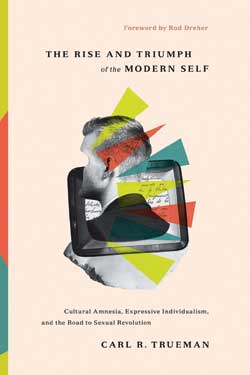
Carl R. Trueman's The Rise & Triumph of the Modern Self is a step-by-step guide meant to address an astounding transformation that has taken place in our culture over the last thirty years. Trueman writes in the Introduction:
"I am a woman trapped in a man's body." My grandfather died in 1994, less than thirty years ago, and yet, had he ever heard that sentence uttered in his presence, I have little doubt that he would have burst out laughing and considered it a piece of incoherent gibberish. And yet today . . . those who think of it as meaningful are not restricted to the veterans of college seminars. . . . They are ordinary people with little or no direct knowledge of the critical postmodern philosophies whose advocates swagger along the corridors of our most hallowed centers of learning.1
How did we get to a place where ideas that seemed farcical just two generations ago have become today's cultural orthodoxy?
Psychologizing the Self
Trueman goes into great detail showing how the locus of modern man's sense of self moved from the transcendent to the immanent. St. Augustine in the fourth century saw himself as naturally wicked in comparison to his Maker. But by the eighteenth century, Jean-Jacques Rousseau had turned that model upside down. To Rousseau, "natural man" was essentially good. It was the external forces generated by society that had corrupted him.
It doesn't take much imagination to see Rousseau's reflection in the postmodern notion that an individual is at his best when he acts in accordance with his fundamental nature. Amour propre, Rousseau called it, "self-love." Trueman continues:
In Rousseau's emphasis on self-love . . . we can see emerging the basic outlines of modern expressive individualism. The real identity of an individual is to be found in the inner psychological autobiography. The authentic individual is one who behaves outwardly in accordance with this inner psychological nature. Society and its conventions are the enemy, suppressing desire and perverting the individual in a way that prevents the real, authentic self from being able to express itself.2
Rousseau framed the picture. The artists filled it in. It is hard to imagine a poet having much influence in our contemporary culture, but Wordsworth, Shelley, Blake, and other Romantic poets were the media stars of their day. They made ideas like Rousseau's palatable to people. Their goal was to awaken the public's heart using emotion in pursuit of an empathy-based view of ethics. This, combined with their attacks on institutional religion and their promotion of sexual liberation, set the stage for Sigmund Freud and the triumph of the erotic.
Sexualizing Psychology
Trueman contends that the Romantics' assault on the transcendent was not meant to promote a view of personal identity seen in sexual terms. They simply attacked institutions like traditional marriage because they saw them as representative of the oppressive societal norms that had corrupted "natural man." Freud just took it one step further:
The genius of Freud, like that of Darwin, lay in his ability to articulate the kind of notions foreshadowed in Shelley and Blake but to do so in a scientific idiom that carries rhetorical power in this modern age. . . . Freud provided a compelling rationale for putting sex and sexual expression at the center of human existence.3
Freud's pseudo-scientific "research" has been debunked for the fraudulent nonsense that it was.4 He manufactured the concepts of the id, ego, and superego out of thin air. He was a cocaine addict and a plagiarist. And his psychoanalysis has been exposed as nothing but a money-making scheme. Frederick Crews, a Freud biographer who has dedicated more than forty years to uncovering the fraud that is Freud, has documented that "Freud lacked a single ex-patient who could testify to the capacity of the psychoanalytic method to yield the specific effects he claimed for it."5
Even so, Freud was successful at linking the science of the Enlightenment with human sexuality. He gave Rousseau's views a distinctly sexual identity while at the same time promoting "scientific reason as the means by which human beings can be reconciled to civilization in a way that avoids the burdens of guilt and anxiety [brought on by] religion."6
In other words, Freud succeeded in selling the myth that sexual desire and fulfillment are the keys to what it means to be human.
Politicizing Sex
The final step into the philosophical cellar in which we now dwell came by marrying a Marxist view of oppression and class warfare with the Freudian view of sexual identity. "To follow Rousseau is to make identity psychological. To follow Freud is to make psychology, and thus identity, sexual. To mesh this combination with Marx is to make identity—and therefore sex—political."7
Marxism and Freudian sexuality may seem like wildly disparate realms of thought. But the twentieth century produced two activist intellectuals who were up to the task of officiating their wedding. Wilhelm Reich and Herbert Marcuse led the charge in academia to cast the psychology of sexual repression as just another manifestation of the same society-wide oppressive forces Rousseau had correctly identified. To them, "the demolition of bourgeois society [was] predicated on the demolition of the sexual regulations that maintain it."8
All of it had to go. And that put a bullseye not only on a patriarchal, traditional view of the family, but also on the infantile religious dogma on which that tradition rested.
Cultural Implications
When we see how these philosophical ideas are intertwined, we can understand many things we see going on today that may otherwise seem inexplicable. The demand that bakers and florists celebrate the sexual proclivities of their patrons, the bodily-autonomy defense of abortion as birth control, and the insistence that others honor one's self-assigned pronouns—all these things descend from the common human proclivity to question, challenge, and rebel, not just against objective morality, but even against reality itself.
Carl Trueman has done us a great service in showing us the twisted thinking that led our culture to defend ideas his grandfather wouldn't have found the least bit funny.
Notes
1. Carl R. Trueman, The Rise and Triumph of the Modern Self (Crossway, 2020), 19.
2. Trueman, 129.
3. Trueman, 202–204.
4. Frederick Crews, The Making of an Illusion (Metropolitan Books, 2017).
5. Fuller Torrey, "The Death of Freud," National Review (Sept. 11, 2017): nationalreview.com/magazine/2017/09/11/frederick-crews-freud-death.
6. Trueman, 216.
7. Trueman, 250.
8. Trueman, 247.
is a graduate of the U. S. Naval Academy (B. S., Aerospace Engineering) and Biola University (M.A., Christian Apologetics). Recently retired, his professional aviation career included 8 years in the U. S. Marine Corps flying the AV-8B Harrier attack jet and nearly 32 years as a commercial airline pilot. Bob blogs about Christianity and the culture at: True Horizon.
Get Salvo in your inbox! This article originally appeared in Salvo, Issue #60, Spring 2022 Copyright © 2026 Salvo | www.salvomag.com https://salvomag.com/article/salvo60/from-sense-to-cellar


