
When Puppies & Plants Replace Children
I've watched with mild embarrassment and frustration as many of my generational compeers delay—or even eschew—parenthood and substitute dogs to fill the role of children. As eggs drift and die like uncourted Austenian spinsters, as sperm dart aimlessly to and fro, ready soldiers never called to arms, it seems that AKC-registered canines are the only ones of God's good creatures taking seriously his commandment to be fruitful and multiply.
Or, to be more accurate, their breeders are the ones pursuing the procreation, collecting deposits on puppies not yet conceived and laughing all the way to the bank. A family member recently paid her way onto an eight-month waiting list for a dog, and an hour or two of internet recon will yield the news that nearly all breeders have been wiped clean of available puppies through the end of 2020.
It takes almost as long to adopt a dog as it does to adopt a child. This is, sadly, appropriate, since the dog, once obtained, is treated like a child. The first indication of this is the wording itself: "adopt." No one buys a dog anymore, which would imply that the dog is a commodity and not a new member of the family. Owners refer to themselves as "dog parents" and to their pets as "fur babies." They send out puppy-adoption announcements. Sometimes they have "gender reveals."
Once they obtain the dog, they take family portraits together with it, and if a cohabiting couple that owns a dog decides to get married, they include the dog in the wedding ceremony. They update friends and family on social media about their dog's progress through developmental milestones, and they throw birthday parties for their pet—or at minimum snap a photo of the dog eating a treat with a party hat strapped to its head.
When, if ever, the couple copulates productively, they announce that the dog is going to be a big brother or sister, a sibling of the expected infant. And, as the pregnant woman grows round, she frets over how the dog (the dog!) will handle the big adjustments to come, and the husband pats her hand and assures her all will be well.
Fussing Over Houseplants
To an extent, I get it. I love dogs, and I have serious reservations about those who do not. And for those who have never had the truly awesome experience of holding your own infant in your arms, of looking into his eyes and seeing yourself, your spouse, a stranger, and God all swirling together in the depths of his pupils and the vibrancy of his irises, I can understand how you might think that parenthood is comparable to taking the dog for a hike and remembering to bring the collapsible water bowl in case it gets thirsty. So I am only mildly embarrassed over all of this "fur baby" nonsense.
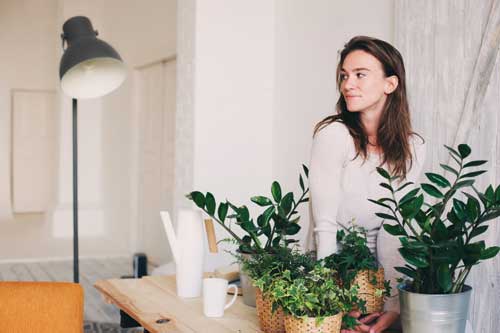
I am, however, mortified to have discovered that a similar substitution is taking place with houseplants. That fauna could replace offspring is an understandable if misguided notion; that flora could do it baffles the mind and offends the heart.
And yet I now come across articles like "5 Psychological Benefits of Having Houseplants," published on Bustle.com on July 26, 2018, in which author Emma McGowan describes giving her large monstera plant a shower, talking to it, and wondering over the plant's growth. She writes:
For me, the main psychological benefit of having plants is having something to care for. I like keeping an eye on their new growth; turning them so they face the sun; making sure they get enough (and not too much) water. I like fussing over them and looking at them and knowing that my love and care keeps them healthy and strong.
The article also quotes "plant stylist" Hilton Carter. He says:
For me, what I love about having plants are [sic] how much life they can bring into your home. They create so much warmth and euphoria, it makes you never want to leave. I also love watching them grow and change overtime [sic]. Seeing a plant you've successfully kept alive grow from a young plant to full grown adulthood is exciting.
In particular, McGowan's phrase "fussing over them" caught my attention, bringing to mind images of a mother tucking a stray hair into her daughter's braid or straightening her son's tie.
Fighting for Space
I had stumbled across McGowan's article while on a hunt to find out if the twenty or so houseplants I keep had any proven psychological or emotional benefits for our young children. As my plant collection has grown, I find myself hunting for reasons to justify the space they take up in our modest home. But because my husband and I want more children, more human life in our house, the fact is, if eventually, the plants will need to find another home, they will.
But that is not the mindset of many in my generation. No, if children get to come into the picture at all, they must squeeze in at the last moment, fighting for standing space next to education, careers, pets, and—God help us—houseplants.
I am ashamed to belong to a generation that can be so easily satisfied, happily delaying parenthood, and settling instead for propagating by cuttings and substituting foliage for flesh.
One can only hope this is as bad as it gets, but I fear pet rocks may be making a resurgence soon.
Elizabeth Nussenis 90 percent a stay-at-home mother and wife, 8 percent a home-school literature teacher, and 2 percent a writer (usually in the hour between 5:00 and 6:00 a.m.). She holds an MA in philosophy, and triple-majored as an undergraduate in English, philosophy, and education.
Get Salvo in your inbox! This article originally appeared in Salvo, Issue #55, Winter 2020 Copyright © 2026 Salvo | www.salvomag.com https://salvomag.com/article/salvo55/slightly-offspring-when-puppies-amp-plants-replace-children


