
Margaret Sanger, Eugenicist
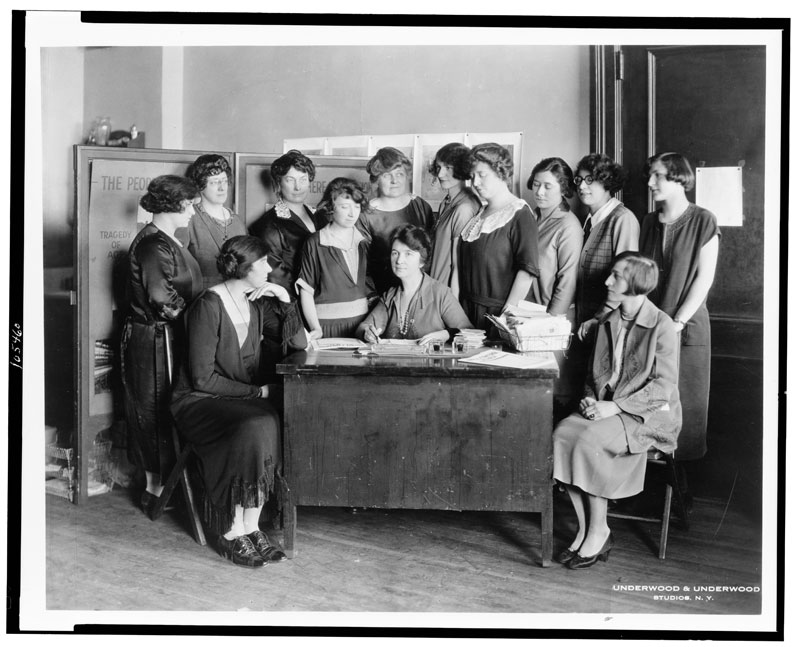
Today we consider Margaret Sanger to be the founder of Planned Parenthood and thus of the abortion movement. And in part, this is true—she did found Planned Parenthood, and her theories lay at the groundwork of the abortion industry in the United States. At the core of her life's work, however, Margaret Sanger really fought hardest for birth control, and she even tried to distance herself from abortion for most of her career. She was, in fact, one of the four people originally responsible for the development of Enovid, the first hormonal contraceptive pill.1
To argue for the necessity of the birth control pill, Sanger wrote convincingly of the plight of the poor women she had served while working as a nurse in the slums of New York. These women, she argued, wanted smaller families—they were suffering physically from the rigors of pregnancy and childbirth, they were exhausted from caring for hordes of children, and they were mired in poverty with no way to get out.
But her motives for wanting birth control went deeper than the gut-wrenching personal stories she told. Combined with those more compassionate inclinations were Sanger's ardently eugenicist and Malthusian leanings.
Birth Control = Eugenics
"Choice" is a crucial concept in the pro-abortion position, but what both Sanger and her close associates wanted was for certain classes of people to "choose" to eliminate themselves. Sanger thought that the promotion of birth control and of a woman's choice to become a mother would create a "new race" of mankind. Once "liberated" from the "slavery" of "involuntary motherhood," as Sanger terms it in Woman and the New Race, women would be free to pursue education, careers, and a more "enlightened" motherhood. They would produce better children, because they themselves would be healthier and more educated. Sanger writes:
Birth control itself, often denounced as a violation of natural law, is nothing more or less than the facilitation of the process of weeding out the unfit, or preventing the birth of defectives or of those who will become defectives.2
In a 1921 article in her journal, The Birth Control Review, Sanger argues for the link between eugenics and birth control even more firmly—and champions the need for both. "[T]he campaign for Birth Control is not merely of eugenic value," she says, "but is practically identical in ideal, with the final aims of Eugenics." She continues:
As an advocate of Birth Control, I wish to take advantage of the present opportunity to point out that the unbalance between the birth rate of the "unfit" and the "fit," admittedly the greatest present menace to civilization, can never be rectified by the inauguration of a cradle competition between these two classes. In this matter, the example of the inferior classes, the fertility of the feeble-minded, the mentally defective, the poverty-stricken classes, should not be held up for emulation to the mentally and physically fit though less fertile parents of the educated and well-to-do classes. On the contrary, the most urgent problem today is how to limit and discourage the over-fertility of the mentally and physically defective.3
To summarize: the poor and otherwise "unfit" have too many children, outnumber the wealthy and educated, and are thus a "menace to society." But the wealthy will never manage to outbreed the poor. So instead, birth control propaganda must be deployed to convince the poor of the benefits of limiting their fertility.
Again, in Woman and the New Race:
If we are to develop in America a new race with a racial soul, we must keep the birth rate within the scope of our ability to understand as well as to educate. We must not encourage reproduction beyond our capacity to assimilate our numbers so as to make the coming generation into such physically fit, mentally capable, socially alert individuals as are the ideal of a democracy.
In this view, eugenic birth control is a necessary component to a functioning democracy. The United States needs to be able to "assimilate" its "numbers"—i.e., all those born—into the ideals and convictions of the educated and wealthy upper classes. Since it would be impossible to assimilate a great many poor, uneducated, unintelligent, or physically unfit people, they would be a drain on the whole system—and also get out of the control of the elites.
Telltale Company
Not only was Sanger herself a eugenicist, but so also were the people with whom she surrounded herself. During a trip to England (she fled the country in 1914 rather than face charges related to distributing birth control materials), she spent significant time with Havelock Ellis, a British physician who wrote widely on issues of sexuality. Ellis shared Sanger's leanings, writing at one time, "The superficially sympathetic man flings a coin to the beggar; the more deeply sympathetic man builds an almshouse for him so he need no longer beg; but perhaps the most radically sympathetic of all is the man who arranges that the beggar shall not be born."4
The journal that Sanger helped to found, The Birth Control Review, frequently published prominent eugenicist voices. Take, for example, the article, "Eugenic Sterilization: An Urgent Need," which appeared in the April 1933 issue. The author of this piece, Dr. Ernst Rudin, was a chief eugenicist under the Nazi regime, and responsible for the mass sterilization and murder of thousands.
Elitist & Disdainful
Did Sanger want to help poor woman? Arguably, yes. Her experience as a nurse in the impoverished neighborhoods of New York gave her ample exposure to women who were struggling to make ends meet, women who were physically worn down with heavy work and poverty. But hand-in-hand with her sympathetic view of the poor was Sanger's elitist, paternalistic, and disdainful view toward them. They were to be rooted out, sterilized; their numbers were to be reduced enough that they could be controlled by the educated elite. The "defectives" must be eliminated, or else they would overrun the democracy. Or, as she wrote in Woman and the New Race, "The most merciful thing a large family can do to one of its infant members is to kill it."
These are historical realities that many in liberal or feminist circles would prefer to ignore or forget, but the truth is that both contraception and abortion were strongly endorsed by those in the eugenicist movement as a means to "better" mankind by "weeding out the unfit." And this historical reality still echoes in modern-day efforts at reducing or controlling the fertility of poorer women.
For an example of this, take a trip to a local county health department. Alongside pamphlets on communicable diseases and childhood vaccines, there will almost always be a large assortment of pamphlets, advertisements, wall notices, and such like encouraging female clients to talk to someone about their birth control options, or even explaining the rationale for child spacing.
Such literature is but the legacy of Sanger and the other eugenicists responsible for the mass promotion of contraception and abortion at the beginning of the twentieth century. Alongside the rhetoric of "choice" is the admonition to choose "wisely"—meaning to have fewer children. But behind such efforts lies prideful and elitist disdain for the poor, the working classes, and the handicapped.
Notes
1. For more on this, see Jonathan Eig, The Birth of the Pill (Norton, 2014).
2. Margaret Sanger, Woman and the New Race (1920), republished by Project Gutenberg (2005), available at gutenberg.org/cache/epub/8660/pg8660-images.html. Quote to be found in Chapter 13.
3. Margaret Sanger, "The Eugenic Value of Birth Control Propaganda," Birth Control Review (October 1921), available at nyu.edu/projects/sanger/webedition/app/documents/show.php?sangerDoc=238946.xml.
4. Quoted in Daniel J. Keyles, In the Name of Eugenics: Genetics and the Use of Human Heredity (Harvard Univ. Press, 1995), p. 90.
is the managing editor of The Natural Family, the quarterly publication of the International Organization for the Family.
Get Salvo in your inbox! This article originally appeared in Salvo, Issue #54, Fall 2020 Copyright © 2026 Salvo | www.salvomag.com https://salvomag.com/article/salvo54/aborting-the-beggar


