
"The Chosen" Both Faithfully & Innovatively Presents the Gospels
Fans of Christian film who are familiar with the name Dallas Jenkins likely know it from What If?, The Resurrection of Gavin Stone,or A Midnight Clear, his three best-know works. Connoisseurs of Christian pop culture in the broader sense will likely recognize the Jenkins family name from the Left Behind series of Christian fiction best-sellers from the 1990s and early 2000s and the movies based on them. Those familiar with both Dallas Jenkins's earlier work and his Christian media pedigree would be utterly surprised by the scope and ambition of his newest project, a streaming series called The Chosen.
In format, The Chosen aims to be a multi-season series with a closed narrative arc in the mode of Game of Thrones, The Sopranos, and Breaking Bad. But its subject matter is about as far from that of those series as sunrise from twilight. The Chosen is the first multi-season series based on the Gospels. Not one single Gospel, as has been done in many theatrical films, TV films, and mini-series over the years, but all four of them.
This puts the work of Jenkins and his writing team fully within a tradition of Christian drama and biblical literature stretching back past the Reformation to the medieval Gospel plays and even to the ancient Gospel harmonies such as the Diatessaron. But in modern film and television, the undertaking is completely unprecedented. It is this aspect of The Chosen that has already drawn considerable media attention to the series, in Christianity Today, World, Plugged In, and numerous Christian entertainment blogs.
Innovative Marketing
The means of distribution is also unprecedented. VidAngel, the production and distribution company behind The Chosen, aims to put its presentation of the Gospels into as many hands as possible by releasing the series first and primarily as an app downloadable from Google Play or the Apple Store. DVD and Blue Ray copies of the series can be purchased of course, but VidAngel has opted to give pride of place to this new and revolutionary means of bringing its finished product to consumers.
The way the series is being funded is also a radical departure from anything done before in Christian media. The producers of The Chosen have embraced and combined the global trends of streaming and crowdfunding. As of this writing, the series has set a record for money raised through crowdfunding for a project of this kind ($11 million for season 1 and a bit over $3 million for season 2; you can monitor the progress of the online fundraising campaign from their online store.1 The production and filming of the series are therefore proceeding on a pay-as-you go model, unheard of in Hollywood.
The decision to market the series primarily by means of an app rather than by streaming it through an existing service is also ground-breaking. Sure, Netflix, YouTube, and Amazon shows can be viewed through their respective apps, but in these cases the viewer is watching the show through an app controlled by Netflix or Amazon and not by the series' creators themselves. The Chosen is an app unto itself, making it independent of any platform that would deprive the people making the show of their direct control of distribution. This certainly obviates the risk that any of these platforms would block or de-monetize the series for ideological reasons (e.g., "So, Mr. Jenkins, that line where Jesus says, 'I am the way, the truth, and the life'? You need to re-write that so he says, 'I am one of the ways to the truth and the life'; you know, for our Buddhist, Hindu, and Muslim viewers. We can't afford to lose market share.").
More importantly, releasing the series in the form of an app serves the evangelistic purpose of getting this dramatization of the Gospels, the life of Jesus and his disciples, into the hands of as many people as possible as quickly as possible. Social media campaigns promoting the series are quite active on both Facebook and Twitter. The free global livestreaming event for The Chosen that took place on YouTube during Easter week drew, depending on the episode, between 250,000 and 512,000 views.
Perceptive Writing
The format and marketing approach, however, are not the only aspects of the series that distinguish it very significantly from biblical films and mini-series of the past. The Chosen provides a coherent and character-rich narrative that fills in historical details and gives context to the Gospel narratives—the origin of Jacob's Well, for example, and Moses' act of forging the bronze serpent—in part by providing the backgrounds of the major characters in the series. Megan Basham at World magazinedescribed the challenge of doing this:
It's a dicey prospect: inventing backstories and side plots for Bible characters without undermining the source material. That Jenkins and his team navigate these hazardous waters without wrecking their ship on the rocks of contradiction, as so many big studio and network productions have, is thanks to a deep theological understanding of the New Testament. The series doesn't just check off events as they occur chronologically. It uses creative camera shots, flashbacks, and quick references to the Old Testament to make a holistic case for Jesus as the Messiah.
As Jenkins states in an interview posted on The Chosen's Facebook page, those more speculative aspects of the series, along with the references to the Torah and the prophets as the context for Jesus' life on earth, are all informed by input from Catholic, Evangelical, and Messianic Jewish Bible scholars. The writing team aims for cultural and theological consonance with the biblical sources in these elements of the story but also for greater psychological and emotional breadth.
We all know, for example, that the brothers Peter and Andrew had lives before they met Jesus, and that they made their living as fishermen. The series enhances the depiction of their life situation by adding more social/interpersonal details and easily relatable touches than are usually found in dramas of this sort. Similarly, we know from the text of John 3 that Nicodemus was a teacher of Israel, but it is a rare biblical drama that allows the audience to see him teaching, attempting to perform an exorcism, and dealing with the bureaucratic inconveniences imposed on the Jewish people by their Roman conquerors—in short, to see him doing the sorts of things that would be required of a leading first-century rabbi.
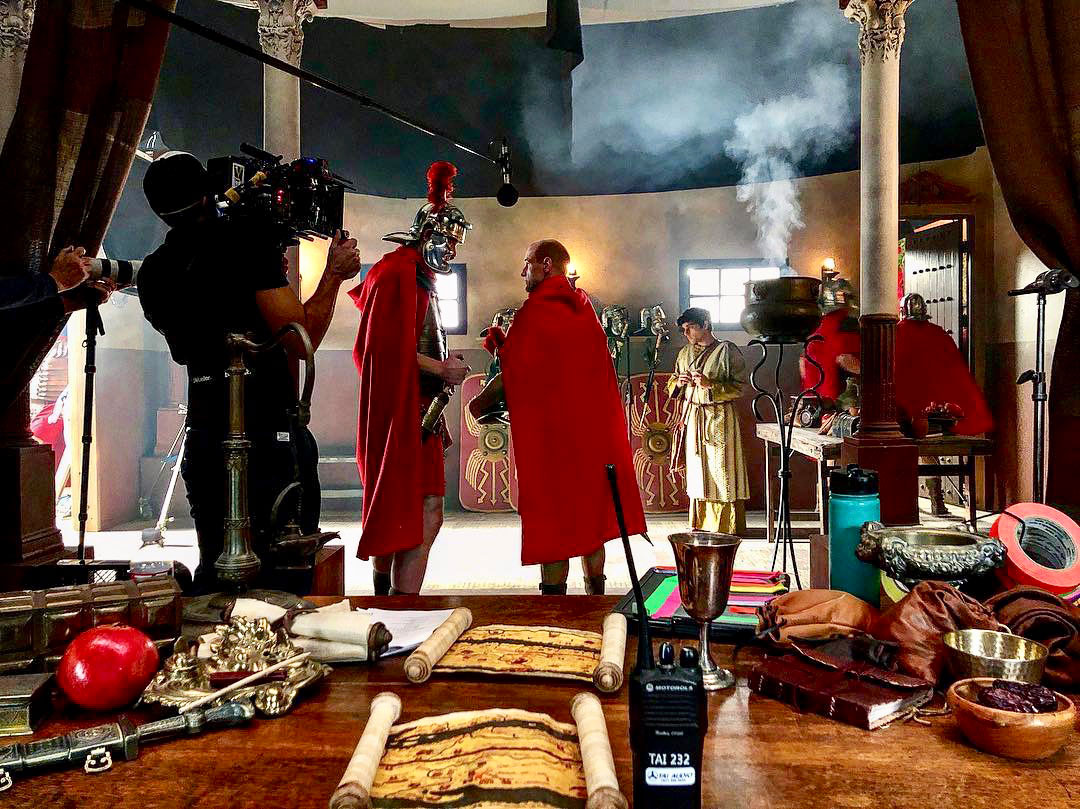
Another remarkable aspect of the series is the depth it lends to the Roman praetor Quintus and the centurion Gaius. Quintus is witty, charming, and absolutely determined to assert Roman power. He is also contemptuous of the conquered Jewish people, sometimes subtly, other times openly. Gaius is himself from a conquered people (the Germanic tribes of central Europe) and has made the decision to "join the winning side"—to use the dialogue from the series.
The addition of these relationships and characters does not detract from the series' commitment to bring the gospel to its audience; rather, it serves to give the characters a depth that is almost always lacking in Bible-based films and television shows.
Convincing Acting
Nevertheless, however well-written, none of that added depth would be conveyed effectively without an excellent cast portraying these characters. None of the actors are exactly household names. The two with the broadest experience, Erick Avari and Brandon Potter, have surprisingly extensive experience as a character actor and voice actor respectively. Both are thoroughly persuasive in their respective roles as Nicodemus and Quintus.
But the real stand-outs in this first season have been Paras Patel, Elizabeth Tabish, and Jonathan Roumie. Patel gives us a Matthew as we have never seen him depicted before: he is younger than the other disciples and has Asperger syndrome. Tabish's excellent performance as Mary Magdalene (depicted both before and after being delivered from demonic possession) is all the more impressive because it is her first work in series television. Roumie's portrayal of Jesus is noteworthy for its careful avoidance of the "and now I speak Scripture" tone when actual words from the Gospels are spoken. Roumie delivers that dialogue with the same kind of natural cadences as he does the other, more speculative dialogue. There is no jarring discontinuity between the flow of Jesus' conversations with Simon (played by Shahar Isaac), Andrew (played by Noah James), and Eden (Simon's wife, played by Lara Silva) in their house while they are preparing for his meeting with Nicodemus (episode 7, "Invitations") and his manner of teaching at the house of Zebedee (episode 6, "Indescribable Compassion").
The writers and actors have presented these familiar scenes and characters from the New Testament with a depth and complexity that have rarely been seen on film. Indeed, Roumie's depiction of Jesus, informed by the actor's own faith, aims at conveying humor and warmth in the person of the Savior of the world, aspects that are generally absent from most screen portrayals of Jesus.
While it is remarkable how well this group of character actors, some with little or no prior experience in film or television, carry off their individual roles, it is even more remarkable how well they perform as an ensemble. The fraternal dynamic between Andrew and Simon feels authentic, which is quite a credit to both the writers and the actors. Similarly, the dynamic between the Roman authority figures, Quintus and Gaius, and their Jewish subjects seems both eminently human and fraught with potential menace for the Jewish characters. This is not an easy dynamic to convey, and the cast of The Chosen does so convincingly. The best cinematic parallel I can think of is the relationship between Commandant von Luger and the Allied officers Ramsey and Bartlett in The Great Escape. That is to say, the cast of The Chosen has faced some remarkable dramatic challenges in their material and their characters and mastered them.
Minor Flaws
There are, of course, flaws in The Chosen. It faces tight budget constraints (approximately $1,100,000 is budgeted for each episode), and this is reflected in some of the costuming and set work. Though the dialogue is generally very well-written and employs a breadth of vocabulary lacking even in supposedly high-quality American television, there are occasional lapses. No one in the first century a.d. would have said "okay," and there are plenty of modern words that would better retain the illusion of "long ago and far away." And there is one place in the otherwise excellent depiction of the meeting between Jesus and Nicodemus in which modern sensibilities come crashing in like a bag of lead shot onto the floor.
But these are minor flaws in a surprisingly fresh and intelligent biblical drama that is being delivered to the world through a revolutionary new method. The funding for season 2 is still incomplete as of this writing (late April), and it is sincerely to be hoped that the crowdfunding effort does not fall prey to the economic dislocations brought about by the Covid-19 crisis.
Note
1. https://studios.vidangel.com/the-chosen/store.
is a professional translator, missionary, and writer living in Germany, where he works with several different ministries, and lives in a Christian intentional community. He has written academic articles on medieval literature and culture and has published essays in Salvo, First Things, and Boundless. He is a native of Indiana.
Get Salvo in your inbox! This article originally appeared in Salvo, Issue #54, Fall 2020 Copyright © 2026 Salvo | www.salvomag.com https://salvomag.com/article/salvo54/a-unique-cultural-phenomenon


